
A mobile home breaker box should be selected by its job, approved equipment and actual supply, not by the words on a store shelf. The box inside your home and the equipment beside the meter may serve different purposes. Replacing either one starts with identifying that arrangement.
For a repair, ask which component failed and whether the surrounding panel remains suitable. For an upgrade, separate circuit space from electrical capacity. A bigger enclosure can solve a space problem without increasing the power available to your home.
Identify which mobile home breaker box you mean
Start with the location and function of the equipment you want assessed. A meter measures electricity use. A disconnect provides a way to disconnect a defined supply, while a distribution panel divides power among branch circuits.
These functions can share an enclosure. They can also occupy separate boxes, with an exterior service disconnect feeding an interior distribution panel. The word “main” on an indoor breaker doesn’t establish that the panel is the service equipment.
| Equipment you mean | What the assessment must identify | What a store description cannot settle |
|---|---|---|
| Interior distribution panel | Supply arrangement, approved breakers, panel condition, capacity and mounting | Whether a larger box can use the existing feeder and circuits |
| Outside disconnect or power pedestal | Service role, weather exposure, supply protection and utility requirements | Whether a trailer panel listing matches this installation |
| Meter socket or combined meter equipment | Utility acceptance, ownership, service arrangement and required disconnecting equipment | Whether an electrician can replace it without utility coordination |
| One circuit breaker | Cause of the problem, exact panel compatibility and required protection | Whether matching amperage or shape makes it a suitable substitute |
A feeder is the supply circuit between upstream equipment and downstream distribution equipment. Branch circuits then serve lights, receptacles and appliances. Keeping those terms separate helps you understand which wiring and equipment a quote includes.
If your problem involves several rooms, uncertain circuit labels or changes after an outage, describe the pattern first. The broader manufactured home electrical system guide explains those boundaries. A dead room alone doesn’t establish that you need a new panel.
Make a panel record without removing covers
Collect existing inspection records, installation documents and photographs supplied by earlier electricians. Record the home manufacturer, model and available serial information. Add the location of each electrical enclosure and any planned appliance changes.
Photograph identification only when plainly visible through normal, safe access. Leave the screwed cover, protective interior cover and any concealed labels alone. Write “unknown” where information isn’t available.
- Panel identity: Manufacturer, complete catalog number and equipment type from available labels or records.
- Separate ratings: Panel rating, visible main handle rating and documented upstream supply rating, each labeled by source.
- Installation: Indoor or exposed location, recessed or surface mounting, and existing wall or siding condition.
- Reason for work: New circuit, recurring fault, missing protective cover, visible damage or a documented replacement recommendation.
- History: Previous repairs, water entry, a recent move, added equipment and missing approvals.
Don’t use a cover number as the sole identification of the complete panel. A trim, interior assembly and enclosure can have separate identifiers. Ask the electrician to reconcile them when ordering a replacement or investigating a recall.
A circuit directory is useful context, but it may be outdated. Share it as an existing record rather than proof of every connection. Have the contractor provide a corrected directory after the work.
Panel replacement also needs an access plan. Tell the contractor about furniture, cabinets or an enclosed porch near the equipment. Don’t remove finishes or cut a larger opening before the replacement location and work scope are approved.
Separate four questions before choosing equipment
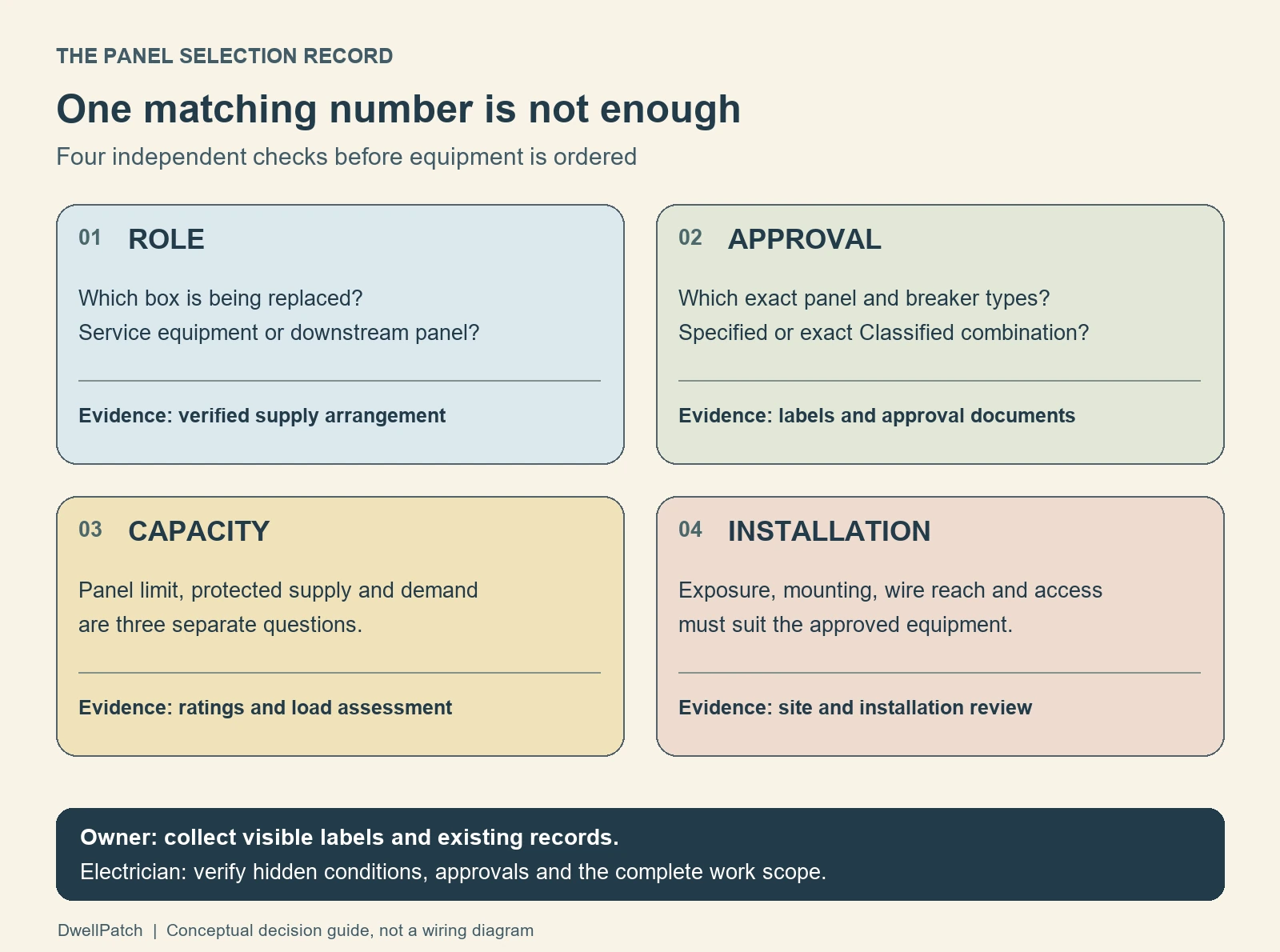
A suitable panel has to pass four different checks: its function, its permitted components, its electrical capacity and its physical installation. Passing one doesn’t answer the other three. This is the reason two boxes advertised with the same amperage may require very different projects.
1. What role will the panel serve?
A main breaker panel contains a breaker at its incoming connection. A main lug panel receives supply at terminals without an integral main breaker. Neither description alone establishes the correct use in your home.
The electrician must identify upstream protection and required disconnects before selecting either design. Replacing an existing main breaker panel with a main lug version isn’t simply a cheaper equivalent. Ask what supplies the required disconnecting and protective functions.
Grounding and neutral connections depend on that verified arrangement. The ordinary feeder supplied configuration separates the neutral from equipment grounding inside the home. The federal grounding provision also recognizes an exception when service equipment is installed on the home.
This is why an interior panel isn’t always correctly described as a subpanel. Have the electrician establish the service location and document the applicable arrangement. Don’t copy a photograph, add a bonding screw or change connections yourself.
2. Which components are approved together?
The panel, breaker family, protection functions and accessories must form an approved combination. A breaker fitting onto the mounting hardware isn’t enough. Neither is a matching brand name.
For example, QO and Homeline are different Square D branch breaker families. Their branch breakers aren’t interchangeable merely because the manufacturer is the same. A brand only shopping list leaves out a crucial part of the identification.
Some replacements instead use a documented Classified compatibility route. UL Solutions explains that a Classified breaker compatibility list identifies specific panelboards and application limits. That is a defined combination, not permission to mix any two brands.
Manufacturer positions can differ about replacements from other brands and warranty coverage. Ask the electrician to identify the exact approval basis, application limits and responsible authority’s acceptance. An online interchange chart or seller’s assurance doesn’t resolve those questions.
Our parts compatibility guide applies the same principle across the home. The product category tells you where to start looking. The installed system determines what can actually be used.
3. How much usable capacity is available?
Panel rating, upstream protection, conductor capacity and calculated demand are separate facts. The panel’s rating is an equipment limit. It doesn’t tell you how much power the supply can deliver.
An electrician may approve a panel rated above its protected supply. That doesn’t make the supply larger. The complete arrangement must still protect the conductors and remain within all applicable equipment limits.
For illustration, a panel bearing a 200 amp rating isn’t evidence of an approved 200 amp supply. An upstream protective device and existing feeder may establish a lower limit. This example explains the distinction; it doesn’t approve any particular installation.
Don’t add all the branch breaker numbers to estimate the required service. Ask for the applicable load calculation using actual equipment and planned additions. Electric heating, cooling, cooking, water heating and vehicle charging can change the assessment.
Include exact proposed equipment models in your request. The heating and cooling planning guide explains why a comfort upgrade starts with the whole system. Choosing an HVAC unit and an electrical upgrade independently can leave a missing requirement between the two quotes.
4. Will the installation physically work?
Indoor or outdoor suitability and flush or surface mounting are separate choices. Flush mounting means the enclosure is recessed into the wall. It doesn’t establish weather suitability.
An exterior recessed panel needs equipment approved for that application and a suitable wall detail. An indoor enclosure isn’t made suitable outdoors by adding siding around it. Have the electrician confirm the exact enclosure, mounting instructions and exposure.
Compare the complete replacement dimensions, cable entry locations and required working space. Existing conductors may not reach the new connection points. The contractor should assess permitted extensions, rerouting or cable replacement before equipment is ordered.
Ask whether conductor extensions would need a separate accessible enclosure. Have the contractor identify its approved location before anyone closes the wall. Include access, wall repair and weather detailing in the quote.
A spare breaker position doesn’t prove room for a new circuit
Spaces describe physical positions in the panel. Circuit count describes its permitted circuit arrangement. Both differ from the available electrical capacity.
A tandem breaker places two independent circuit breakers within one physical space in an approved application. It isn’t automatically allowed in every panel position. The exact panel labeling, breaker type and current manufacturer instructions control that decision.
Protection requirements can also change what fits. An arc fault or ground fault protective breaker may need a different arrangement from the existing ordinary breaker. Two neighboring handles aren’t a substitute for the required approved protection or common operation.
Ask the electrician to count usable approved positions after accounting for the proposed equipment. A blank in the door may conceal no usable position. Conversely, a full panel may have an approved expansion option, but only after assessment.
The question for a new circuit is therefore broader than “Can another breaker fit?” Request confirmation of load capacity, proper protection, permitted connection space and a suitable cable route. That produces a useful expansion decision instead of a guess based on the door.
Decide between diagnosis, a breaker repair and panel replacement
A repeated trip can mean the protective device is responding to a real fault. It doesn’t prove the breaker is defective. Don’t install a larger breaker or bypass protective functions to keep the circuit operating.
Burning odors, unusual buzzing, visible discoloration or shocks need prompt professional attention. Stay away from suspect equipment and stop using affected equipment when safe. Smoke, fire or active sparking calls for evacuation and emergency help from a safe location.
Don’t touch the enclosure to check whether it’s hot. Don’t remove the cover or repeatedly reset a breaker to reproduce a failure. A main handle being off also doesn’t establish that all parts inside are safe.
| Reason for the proposal | Evidence to request | Decision still needed |
|---|---|---|
| One breaker is said to be defective | Diagnosis, exact replacement type and assessment of its connection to the panel | Whether the circuit and panel are otherwise suitable |
| Heat or damaged connections are reported | Which breaker, terminal, bus or conductors were affected | Whether approved repair is possible or replacement is needed |
| Panel is full | Approved circuit arrangement and demand assessment | Permitted expansion versus a larger distribution assembly |
| More supply capacity is proposed | Load calculation and review of the complete supply path | Utility, feeder, service equipment and home changes required |
| Older equipment is unsupported | Exact identity, documented condition and replacement options | Extent of replacement and treatment of existing circuits |
A new breaker alone doesn’t document the condition of the bus where it connects. The bus is the panel’s conductive distribution assembly. If damage extends into it, ask how the proposal addresses that damage rather than just the removable component.
Older equipment needs specific identification, not a blanket age verdict. Ask for the exact legacy family and the evidence behind a replacement recommendation. The absence of a recall doesn’t certify that the panel is sound.
Likewise, a new panel doesn’t renew the wiring throughout the home. Existing circuit defects, damaged insulation or unsuitable alterations need their own scope. Request a written list of what was assessed and what remains outside the project.
Check recalls by exact identity before paying for a repair
A mobile home breaker box can be part of a recall affecting equipment used in several building types. Match the actual product family, catalog information and date criteria. The age of the home alone won’t tell you whether a later installed panel qualifies.
The 2022 QO load center recall illustrates the need for precise identification. It covers specified products and manufacturing periods, with a trained electrician assessing the remedy. It doesn’t apply to every panel carrying the same brand.
Some identifying codes are concealed and require a qualified electrician to locate. Don’t remove a cover to search for them. Contact the recall administrator with the information you already have and follow the notice’s directions.
For legacy equipment, distinguish a recall notice from an investigation or a manufacturer’s discontinued product record. Those documents answer different questions. Ask the electrician to explain the actual condition and supporting evidence without treating a missing recall as a clean bill of health.
Compare replacement quotes by scope, not box price
A mobile home breaker box quote needs more detail than the retail enclosure price. It should identify the complete assembly and work needed to make it suitable. Ask for a written explanation of the following items before comparing totals.
- Equipment: Exact panel, included breakers, protective functions, cover, accessories and approval basis.
- Supply: Existing feeder retained or replaced, upstream equipment changes and the capacity being provided.
- Circuits: Existing circuits assessed, cable extensions or rerouting, and defects that would trigger extra work.
- Building work: Opening changes, enclosure support, siding or wall repairs, sealing and access restoration.
- Coordination: Utility disconnection and reconnection, permits, inspections and expected outage arrangements.
- Completion: Revised directory, required testing, approvals, equipment documents and remaining limitations.
Clarify who restores the exterior around outdoor equipment. Electrical work and rain control need to be coordinated. The exterior repair planning guide helps define the surrounding wall and water entry scope.
Ask the utility and contractor which party controls the meter and service connection work. Responsibility varies by installation and provider. Don’t assume the electrician’s price includes utility work or every enclosure visible on a pole.
Approval routes can also differ inside and outside the home. Washington’s manufactured home permit guidance distinguishes those locations and lists main panel replacement as permit work. Your own authority must identify the requirements for your project.
Current factory construction rules are useful context, but they aren’t a universal retrofit permit. Ask which rules govern the existing alteration and who will obtain approval. Get that answer before buying equipment or scheduling finish repairs.
Finally, confirm the outage plan before the job begins. Tell the contractor about essential powered equipment so interruptions can be addressed in advance. Keep the final scope, approved equipment identities and inspection records with your home documents.
Found a detail that needs checking? Tell us about a correction.