

Your mobile home electrical system includes more than the breaker panel inside the house. The supply connection, disconnects, branch circuits and installed devices all matter. Learn their roles before buying replacement parts or treating a dead room as a failed breaker.
Start with visible labels, existing records and the pattern of the problem. Leave covers, terminals, wiring connections and electrical measurements to a qualified electrician. A useful owner record can narrow the work without exposing anyone to live equipment.
First separate an emergency from a service appointment
Smoke, active sparking or fire calls for evacuation and emergency help from a safe location. Stay away from damaged service equipment and fallen wires. Report damaged utility connections to your electric provider.
Burning odors, discoloration, unusual buzzing and shocks also need prompt professional attention. Stop using the affected equipment. Don’t touch a suspect outlet or panel to judge its temperature.
Repeated trips are another reason to stop and arrange investigation. A breaker that holds after several attempts hasn’t proved the circuit is sound. Never install a larger breaker to silence the symptom.
Keep water out of the decision path. If a plumbing leak reaches electrical equipment, avoid that area and arrange both electrical and plumbing assessment. Don’t reach through water to operate a switch.
Map the supply, panel and affected locations
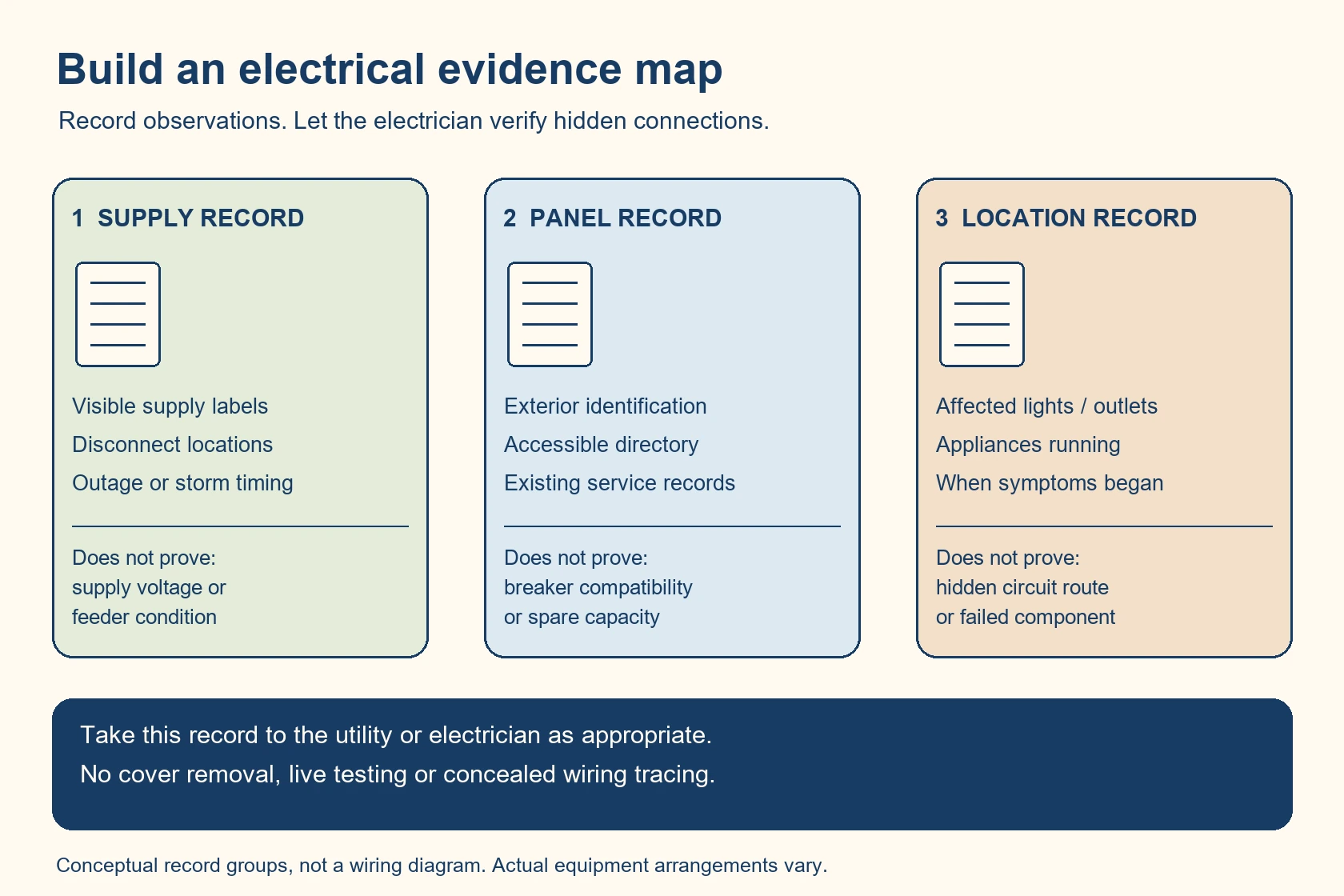
A mobile home electrical problem becomes easier to describe when you separate three levels: the incoming supply, distribution equipment and affected locations. These levels organize information. They don’t identify the defective part.
Use the table as a record of what you already know. Photograph labels only when they are plainly visible and safe to approach. An unreadable or inaccessible label belongs in the record as unknown.
| Level | Useful record | What it cannot establish |
|---|---|---|
| Supply and disconnects | Locations, visible labels, utility account, recorded supply rating and recent outage history | Voltage quality, concealed feeder condition or who owns every component |
| Distribution panel | Exterior identification, accessible circuit directory, inspection paperwork and existing photographs | Breaker compatibility, conductor size, internal damage or spare capacity |
| Affected locations | Which lights, receptacles and appliances stopped working, when, and what else was running | The first device in the circuit, hidden cable route or failed connection |
Keep observations separate from assumptions. Write “bedroom lights and hallway receptacle went off together,” rather than “the bedroom breaker failed.” The first statement helps diagnosis even when the directory is wrong.
A quick sketch can show room names and the affected devices. Mark locations you haven’t checked as unknown. Don’t add connecting lines that imply you traced concealed wiring.
Understand what the electrical components do
The meter measures electricity use
The utility meter serves a different purpose from the disconnect or the home’s distribution panel. Equipment may share an enclosure, which can make the boundary confusing. Ask the utility to identify its equipment and the customer’s responsibilities.
A display on the meter doesn’t establish that every circuit has a healthy supply. Likewise, your neighbor having power doesn’t prove your connection works. Report the actual condition of your home when contacting the utility.
A disconnect opens a defined part of the supply
The disconnect provides a means to disconnect conductors from their source. Its location and arrangement depend on the installation. The exterior equipment and an interior main handle can have different roles.
Locate them before trouble occurs, using existing labels or professional guidance. Don’t assume that moving one handle makes every enclosure safe inside. Some electrical parts can remain energized even with a main breaker off.
The panel distributes power to branch circuits
Branch circuits supply lights, receptacles and appliances through their protective devices. Several rooms can share a circuit. A large appliance can have a circuit that serves it alone.
Open spaces in the directory aren’t permission to add equipment. A blank position, available connection and adequate electrical capacity are different questions. An electrician must establish each one before adding a circuit.
Keep access clear and don’t turn the panel area into storage. Read a directory through normal safe access only. Removing the screwed cover or reaching inside belongs to the electrician.
What differs in a manufactured home
The federal manufactured home electrical standard covers equipment and supply connections. Its ordinary system scope is nominally 120/240 volts. That describes the system, not an instruction to measure live parts.
Factory construction, site connections and later alterations create different records. An old home may also contain changes made long after manufacture. Its present condition needs assessment rather than an assumption based on its original label.
A permanent feeder isn’t a temporary extension cord
The federal standard recognizes a permanent supply circuit and certain listed manufactured home supply cords. A permitted cord assembly has defined application requirements. A household extension cord or improvised adapter isn’t a substitute.
Don’t infer supply capacity from the home’s width or the number of bedrooms. Keep its supply label, original installation instructions and upgrade records together. The electrician can reconcile those documents with the installed equipment.
Outside service equipment is common, but arrangements vary
A home can have outside service equipment feeding its interior distribution panel. Federal provisions also allow service equipment installed on the home under specified conditions. “Every interior panel is always a subpanel” is too broad.
This distinction matters when evaluating grounding and neutral connections. The correct assessment begins by identifying where the service equipment actually is. A photograph of an interior panel door alone cannot settle that question.
Neutral, grounding and chassis bonding have different roles
The neutral carries current in normal operation. Equipment grounding and bonding provide protective connections for metal parts. These functions must remain distinct wherever the verified arrangement requires separation.
The federal grounding provisions include an exception where service equipment is installed on the manufactured home. That exception is why copying another owner’s panel arrangement is risky. Have the electrician identify the applicable arrangement before judging its connections.
A metal chassis doesn’t remove the need for proper grounding and bonding. Nor does a visible rod prove the entire protective path is correct. Don’t add straps, join neutral and ground, or disconnect existing bonds yourself.
Multiple sections add a connection boundary
Homes assembled from multiple sections need appropriate connections between those sections. The federal standard addresses wiring methods for expandable and multiple units. It doesn’t establish one universal connector location for every home.
If symptoms began after moving or setup, include that timing in the service request. Ask for the interconnection arrangements to be checked against the home’s instructions. Don’t crawl underneath to disconnect or reseat electrical connectors.
Choose devices by their installed system
A receptacle sold for a mobile home doesn’t automatically fit the device in your wall. Some installations use a separate electrical box and conventional device. Others use a self contained device with its own enclosure and connection system.
These are different assemblies, even when their visible faces look similar. Mounting depth, wall finish, cable type, conductor condition and available cable length all matter. A new faceplate cannot resolve those questions.
For example, historical Slater SCD instructions specify particular mounting arrangements, cable limitations and assembly tooling. That document describes its own device family. It doesn’t authorize substituting a different product or improvising an assembly method.
Replacing a self contained device with a conventional box can involve more than the retail price of the receptacle. The electrician must establish enclosure fit, proper support and suitable conductors. Extra cable or a revised work scope may be necessary.
Keep the same discipline with breakers. Matching the printed amperage or physical outline alone doesn’t establish compatibility with the panel. Ask for the approved device identification and the reason for replacing it.
The same applies to fixtures. Their electrical rating, location approval and mounting arrangement matter. A light intended for a dry room isn’t automatically suitable over a shower.
Our guide to manufactured home part compatibility explains this approach across repairs. For electrical work, a product category should start the identification process. It should never finish it.
Distinguish breaker, GFCI and AFCI protection
These protections address different faults. A device can include more than one function. Read the exact identification and instructions rather than judging by the presence of a test button.
| Protection | Main purpose | Owner misunderstanding to avoid |
|---|---|---|
| Ordinary circuit breaker | Overload and short circuit protection for the circuit | A breaker staying on doesn’t prove every connection is sound |
| GFCI | Protection against certain electric shock hazards from ground faults | Protection may be upstream rather than at the affected receptacle |
| AFCI | Protection against certain electrical arcing fire hazards | An arc fault trip isn’t solved by removing that protection |
| Dual function AFCI/GFCI device | Both arc fault and ground fault protection | “Combination AFCI” alone doesn’t mean both functions |
The manufacturer’s protection terminology explains the distinction between combination arc protection and dual function protection. It helps you read an estimate accurately. It isn’t a replacement selection chart for every panel.
A protected receptacle can supply other locations downstream. You may therefore lose several outlets when one protective device trips. A room without visible test buttons isn’t proof that protection is absent.
Use only the device’s intended user test procedure, following its exact instructions. A failure to test or reset needs investigation. Never bridge a protective device or fit an ordinary substitute to keep power on.
Describe symptoms without guessing the repair
For mobile home electrical troubleshooting, the most helpful owner contribution is often an accurate timeline. Record what happened naturally. Don’t recreate a trip, spark or flicker to make a video.
| Observed pattern | Record from a safe position | Next action |
|---|---|---|
| One appliance won’t operate | Appliance identity, any displayed message and whether other equipment already works nearby | Arrange appliance or electrical assessment without treating the receptacle as proved faulty |
| Several receptacles or lights stop together | Exact locations, time, observed protective device position and recent work | Have the electrician trace the circuit and its protection |
| A breaker trips repeatedly | Which handle, equipment running and timing, without another deliberate trial | Stop repeated resets and request fault investigation |
| Widespread flicker, unusually bright or dim lights, or partial power | Extent of the change and whether it followed an outage or storm | Report promptly to the utility and arrange electrical assessment |
| Odor, discoloration, buzzing or shocks | Location and timing without touching or approaching the suspected defect | Stop use and seek urgent help; evacuate for smoke, fire or active sparking |
“Half the house is out” describes a pattern, not a confirmed lost supply conductor. A branch circuit fault, protective device or supply problem can need different work. Let the utility and electrician determine the boundary.
A nearby functioning outlet doesn’t establish the next outlet’s wiring path. Likewise, a voltage pen or simple outlet tester cannot certify the whole system. Don’t use a reassuring indication to dismiss odors, discoloration or repeated failures.
Include recent leaks, pest damage, storms, appliance additions and renovation in the timeline. These details help define the investigation. They aren’t proof that any one event caused the fault.
Handle older wiring as an identification problem
Current federal factory standards exclude aluminum conductors in manufactured home branch circuit wiring. That doesn’t prove an older home’s installed conductors are copper. Repairs and undocumented alterations also complicate age based guesses.
Legacy solid aluminum branch wiring requires particular attention to its connections. Don’t identify it by opening the panel or pulling devices from the wall. Ask the electrician to document the conductor type and affected circuits.
The CPSC aluminum wiring repair booklet evaluates permanent repair approaches. It doesn’t endorse ordinary twist connectors or replacing switches alone as a complete permanent remedy. Have the electrician explain the proposed method and its coverage.
Keep the scope specific. A larger aluminum feeder and older solid aluminum branch wiring aren’t interchangeable descriptions. “Aluminum present” is too vague to define either the hazard or the repair.
Request a written record of which connections and circuits were addressed. One new receptacle doesn’t document the rest of the home. Preserve the method, installer details and any remaining limitations with your house records.
Plan upgrades around loads and the complete supply path
A new appliance can change both its branch circuit requirements and the home’s overall electrical demand. A larger panel enclosure alone doesn’t increase the capacity of the feeder or utility service. Those parts must be evaluated together.
Before requesting quotes, list proposed equipment by exact model. Include electric heating, cooling, water heating, cooking and any planned vehicle charging. Provide equipment specification sheets rather than only brand names.
Have the electrician distinguish four decisions: repairing a fault, replacing obsolete equipment, adding a branch circuit and increasing supply capacity. These can overlap, but they aren’t the same project. Ask which evidence justifies each part of the proposal.
Demand calculations require an applicable method and the actual equipment loads. Adding every breaker number together isn’t that calculation. Neither a blanket 100 amp nor 200 amp recommendation answers every owner’s needs.
Coordinate the work before covering walls, replacing cabinets or closing the underbelly. An inaccessible connection can change the repair plan. Keep inspection and access requirements in the schedule.
In wet rooms, include fixture locations and electrical work in the bathroom renovation plan. A separate plumbing system review helps identify water work that needs coordination. Electrical isolation and plumbing isolation remain different tasks.
Ask for a defined inspection and written work scope
Give the contractor the home’s manufacturer, model, serial information and available installation records. Include the observation map and timeline. State whether the home has multiple sections or was recently moved.
Request an investigation of the relevant system boundaries, not an automatic parts list. For intermittent power, that can include supply condition, circuit protection and connection integrity. The electrician should document which portions were actually assessed.
- Identification: Which service, panel, circuit and device arrangements were confirmed?
- Fault: What defect was found, and what evidence supports that finding?
- Scope: Which repairs, access work, finish repairs and equipment changes are included?
- Approval: Who confirms permits, utility coordination and inspection requirements before work starts?
- Closure: Which tests, labels, documents and remaining limitations will be supplied?
Requirements depend on the jurisdiction and the work being done. Washington, for example, distinguishes inside and outside electrical work in its manufactured home permit guidance. That state example isn’t a national exemption list.
Ask the responsible authority which rules govern your existing alteration. A current factory construction provision doesn’t by itself approve a retrofit. Nor does replacing a part with the same rating settle every installation requirement.
Compare quotes by their inclusions before comparing totals. A device replacement quote may exclude cable replacement, wall repairs or utility work. Request those boundaries in writing, including how newly discovered defects will be handled.
Keep a usable mobile home electrical record
After work, retain the invoice, confirmed component identities, revised circuit directory and required inspection approval. Keep photographs supplied by the electrician with the home’s documents. Record unresolved concerns rather than treating a finished invoice as proof every circuit was inspected.
Before a future project, update the equipment list and share this record with the next contractor. Accurate information prevents repeated guesswork about the supply, concealed wiring and past alterations. It also gives you a clear starting point when symptoms change.
Found a detail that needs checking? Tell us about a correction.