
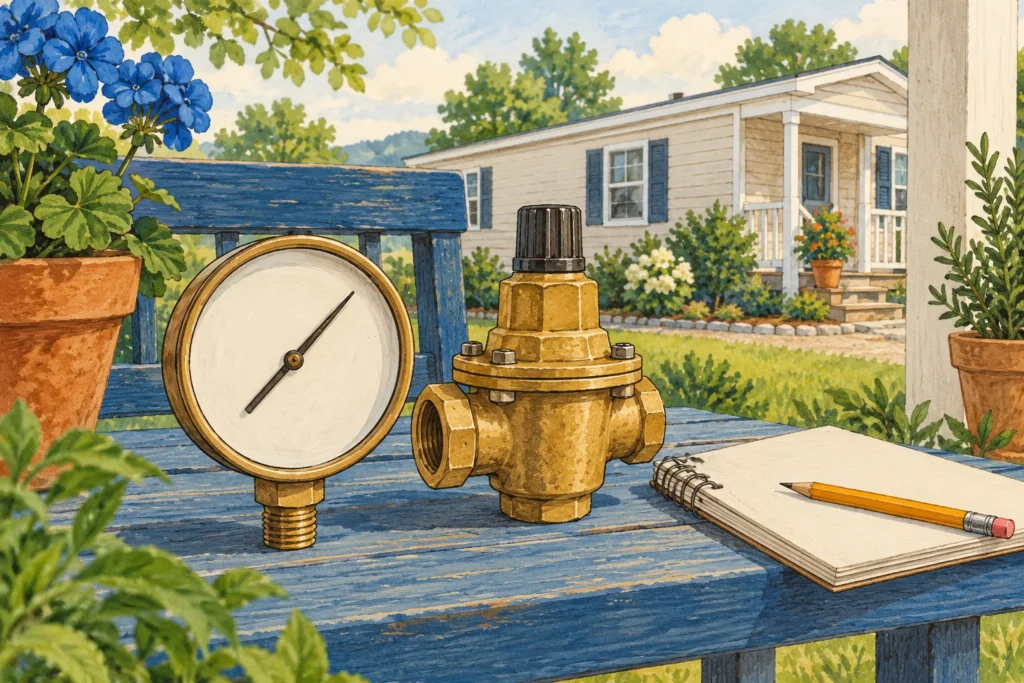
A mobile home water pressure regulator reduces excessive incoming pressure. It cannot create pressure that the supply doesn’t provide. Before buying or adjusting one, identify the valve, measure pressure, and record whether the problem affects one fixture or the whole home.
A weak shower and a high gauge reading can happen together. The useful question is what happens at a known test point while water is off, while fixtures run, and after normal water heating. Those observations help separate a supply problem, a restriction, a regulator issue, and pressure building inside the home.
Does every mobile home need a water pressure regulator?
You can’t tell from the home’s age, size, or siding. Look for installation records, inspect the accessible incoming water service, and ask the water provider about the supply. An older home may have a replacement regulator; another home may receive water through equipment outside your control.
The federal manufactured home installation standard gives a specific trigger. Under 24 CFR 3285.603(b), a reducing valve is required when local supply pressure to the home exceeds 80 psi. This is an installation requirement, not an instruction to set every existing home to 80 psi.
Have an installer confirm the requirements for your existing system and proposed work. Equipment instructions and applicable local requirements also matter. A pressure that stays below that federal trigger can still exceed the operating recommendation for a particular appliance.
For example, the American Water Heater manufactured housing guide numbered 100307779 recommends working pressure of 50 to 60 psi. That recommendation belongs to the equipment guide. It doesn’t turn 50 to 60 psi into a universal setting for every mobile home.
Don’t choose a target from shower feel alone. Give the installer the supply readings, appliance model information, and normal simultaneous water use. Ask for a documented setting that serves the system without exceeding its applicable limits.
Find and identify the mobile home water pressure regulator
Start with the incoming cold water service and its accessible shutoff. Trace only what you can inspect safely. A regulator may be near that service entrance, but a location guess isn’t proof that a particular fitting controls pressure.
The federal installation standard requires an identified, accessible shutoff between the supply and the inlet. It places the shutoff connection riser underneath or adjacent to the home. These provisions help you locate the service; they don’t establish one universal regulator location.
Take a clear photograph of the arrangement and any readable model markings. Include the pipe on both sides, the flow direction arrow, and nearby valves or filters. Don’t turn an unfamiliar screw to discover what it does.
| Component | Its job | What identification still needs |
|---|---|---|
| Water shutoff | Isolates the water supply. | Confirmation that it serves your home and can operate without damaging an old valve. |
| Pressure reducing valve | Reduces higher inlet pressure to a lower downstream pressure. | Maker, model, direction, connections, operating range, and service instructions. |
| Backflow device | Protects against unwanted reverse flow. | Its exact purpose and any required service. Don’t remove it to improve flow. |
| Water heater temperature and pressure relief valve | Provides emergency temperature and pressure protection at the heater. | The heater instructions and a qualified assessment if it discharges. |
| Well pressure switch or tank | Belongs to the pump supply controls. | A well professional’s assessment, rather than house regulator adjustment advice. |
The abbreviation PRV can mean a pressure reducing valve or a pressure relief valve. Write the full component name in your notes. Confusing the two can send a repair in the wrong direction.
If the service equipment belongs to a park or utility, report the symptoms before changing it. Ask where your individual supply begins and whether any pressure control is shared. Keep ownership and permission separate from the technical diagnosis.
Measure pressure and flow as different things
Pressure, reported in pounds per square inch, describes the water’s pressure at the gauge connection. Flow describes the quantity delivered over time. A faucet that fills a container slowly reports a delivery problem; it doesn’t provide a pressure measurement.
With water use stopped, a gauge gives a resting or static reading. During use elsewhere, it shows pressure at that same connection under demand. Write down both conditions, because a resting number alone says little about the water delivered during a shower.
Also identify where the gauge sits in the system. An outdoor faucet may branch off before the regulator. A reading there can’t establish the pressure supplied to indoor fixtures after the regulator.
Sketch the order of the accessible components instead of assuming their positions. Mark the test point as upstream, downstream, or unknown. Unknown is useful information when the alternative is a confident interpretation of the wrong location.
For a simple flow record, use a known container volume and a stopwatch at a safely accessible cold faucet. Record the faucet setting and whether other water was running. Don’t use hot water or handle a heavy overflowing container.
Calculated example: If one gallon takes 30 seconds, the observed flow is 2 gallons per minute. The calculation is 1 gallon x 60 seconds / 30 seconds. It describes that outlet under those conditions, not the capacity of the entire service.
Repeat at the same outlet and setting if you’re comparing before and after observations. Changing the aerator, faucet opening, or competing demand changes the comparison. Keep any collected water for a suitable reuse rather than running repeated unnecessary tests.
Make a pressure record before changing anything
Use a gauge intended for water service with the correct connection and an appropriate range. Check its actual temperature and pressure limits. A similar product name or a fitting that nearly threads on isn’t enough.
A hose connection gauge is useful at a suitable intact cold water hose faucet. Inspect its sealing washer and follow the supplied instructions. Don’t force hose threads onto a pipe thread fitting, improvise adapters on damaged plumbing, or remove an appliance connection just to get a reading.
The Watts IWTG instruction sheet specifies a 3/4 inch hose connection and a red maximum indicator. It also mentions a water heater drain connection. For this initial owner check, use an accessible cold connection; opening an old heater drain introduces heat, sediment, and resealing concerns.
If there isn’t a suitable connection, ask a plumber to arrange the test. Similarly, stop if the faucet won’t close, the gauge leaks, or the connection feels unstable. A short diagnostic check shouldn’t become a broken service line.
- Identify the point. Record its location and whether it is before or after the regulator. If you cannot trace it, mark that uncertainty.
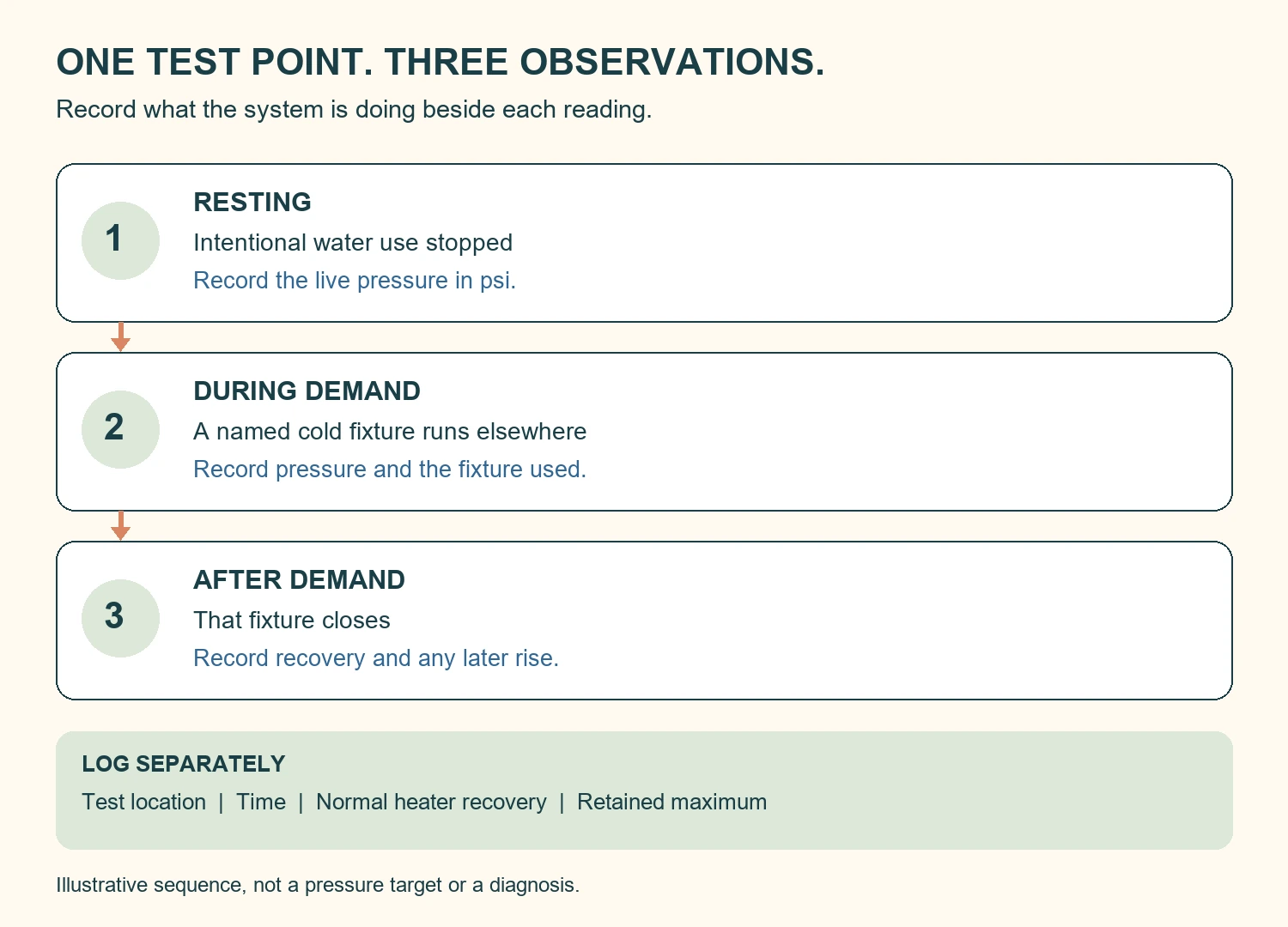
- Record a resting reading. Stop intentional water use, including appliances that may fill automatically. Note any toilet or appliance you hear running.
- Record normal demand. Have someone use an ordinary cold fixture elsewhere while you watch the gauge. Note the fixture and the pressure that settles during use.
- Record recovery. Note the reading after that fixture closes. Write down whether the return is immediate, gradual, or irregular.
- Compare relevant times. Repeat the same observation when the usual complaint occurs. Note normal heater recovery and shared supply activity without changing their controls.
Don’t leave a temporary connection unattended merely to collect more data. Arrange suitable monitoring with a plumber if the complaint occurs overnight or intermittently. After the check, remove the gauge according to its instructions and confirm the faucet closes without leakage.
Copy this observation worksheet
| Record | Your entry | Why it belongs in the report |
|---|---|---|
| Date and exact time | ____ | Makes repeated readings comparable. |
| Test point and regulator side | ____ / before, after, or unknown | Prevents an upstream number from being called house pressure. |
| Gauge model, range, and condition | ____ | Separates instrument uncertainty from plumbing behavior. |
| Resting pressure | ____ psi; all intended use stopped | Documents the starting condition. |
| Demand reading | ____ psi; fixture running: ____ | Connects the number to a named demand. |
| After the fixture closes | ____ psi; recovery pattern: ____ | Records change rather than a single snapshot. |
| Normal heater recovery | Observed, not observed, or unknown | Gives context for pressure rising during no use. |
| Flow observation | ____ gallons in ____ seconds at ____ | Keeps delivery volume distinct from pressure. |
| Fixture pattern and recent changes | ____ | Captures hot versus cold, shared symptoms, and timing after repairs. |
Leave blank fields blank if you couldn’t observe them. Don’t fill a missing upstream measurement with the utility’s estimate. Save that estimate separately with the date and the person or department that supplied it.
What the readings suggest about the next check
The following patterns organize a service call. They are clues, not tests that prove a particular part failed. Several causes can produce the same symptom.
| Observed pattern | Useful next question | Avoid this leap |
|---|---|---|
| One outlet is weak; others remain normal. | Is its aerator, showerhead, local valve, or branch restricted? | Raising pressure for the whole home. |
| Hot outlets are weak; cold outlets remain normal. | Is the problem in the hot supply or heater arrangement? | Condemning the incoming regulator from hot flow alone. |
| Resting pressure looks reasonable but drops sharply during use. | Where is pressure lost as demand increases? | Assuming the resting reading proves adequate supply. |
| All outlets weaken at recurring busy times. | Does the provider see a matching supply change? | Buying a booster before the supply is assessed. |
| Downstream pressure rises again during no use. | Could heater expansion, regulator creep, or debris be involved? | Calling every rise a failed regulator. |
| Only the maximum pointer shows an extreme value. | Can a reliable instrument confirm the event? | Treating a displaced pointer as a complete overnight record. |
For weak delivery, compare every affected fixture before shopping. Portland Water Bureau’s pressure and flow troubleshooting guide separates local fixture problems, hot water problems, and reduced flow throughout the home. That distinction is useful even when another provider serves you.
Check accessible fixture screens according to their instructions and note visible leaks or recent filter service. Don’t dismantle the regulator strainer under pressure. Tell the plumber about a sudden change after a shutoff, repair, freeze, or new filter, because the sequence matters.
A pressure reducing valve isn’t a pump. Increasing its allowed outlet setting cannot overcome inadequate inlet pressure or remove a restriction. A well system also needs its pump, tank, and supply performance assessed before changing house equipment.
Two hypothetical records that lead to different work
Record A: A downstream gauge reads 55 psi with use stopped and 25 psi during a cold faucet draw. The same faucet fills a known container slowly. Those observations justify investigating pressure loss under demand; they don’t identify whether the restriction is upstream or inside the home.
Ask for inlet and outlet measurements under comparable demand. If the inlet also falls, the supply needs attention. If the inlet remains adequate, the installer can investigate the regulator and the intervening plumbing rather than guessing from the shower.
Record B: The gauge reads 55 psi, then rises during a normal heater recovery period with fixtures closed. A later draw returns it toward the earlier reading. That timing makes thermal expansion worth investigating, but it doesn’t clear the regulator or prove an expansion tank has failed.
Both examples start at 55 psi. Their different behavior matters more than that identical starting number. These are teaching examples, not measurements from a DwellPatch installation or acceptable pressure targets.
Pressure creep, thermal expansion, and the red pointer
A regulator controls incoming pressure. It doesn’t automatically solve pressure generated when water heats within a closed system. A check valve or backflow arrangement can prevent expanded water from returning toward the supply.
The manufactured home water heater guide explains expansion tank sizing and pressure matching in its installation section. Have the installer evaluate the actual heater, expansion provisions, and supply arrangement. Don’t recharge or isolate equipment through a generic online procedure.
Don’t assume a regulator’s advertised expansion bypass replaces every other expansion provision. Its behavior depends on the exact model and upstream conditions. Ask how expansion will be managed in your installation, particularly after a new check device, regulator, or heater is added.
A slow rise can also involve regulator seat contamination or pressure creep. Manufacturer troubleshooting lists overlapping possibilities, which is why a single high reading isn’t a diagnosis. A qualified service check should separate them before replacing parts.
With a maximum indicator gauge, record the live needle and the retained maximum separately. A maximum pointer supplies neither the time nor the duration of an event. It also doesn’t tell you which component caused it.
If the red marker swings with handling, fails to hold, or changes when the instrument is disturbed, treat that maximum as unconfirmed. Don’t lubricate or modify the gauge to make a suspect result appear trustworthy. Ask for confirmation with a reliable second instrument or suitable logging equipment.
A live reading can still be useful when the maximum marker is questionable. Conversely, two needles agreeing doesn’t establish calibration. Report the instrument limitation alongside the readings instead of quietly discarding inconvenient results.
Choosing a regulator means checking the whole installation
There isn’t one universally correct mobile home water pressure regulator. Residential reducing valves and small hose connection regulators can appear in the same search results. A product title containing mobile home doesn’t establish suitability for your permanent service.
Have the installer identify the intended potable water application, pipe material, actual connections, and pressure range. Matching the nominal connection size alone doesn’t establish capacity. It also doesn’t prove that a replacement will mate with existing unions.
The maker’s sizing process should consider inlet pressure, desired outlet pressure, required flow, and acceptable outlet pressure during that flow. Write those requirements on the estimate. A valve selected only because it fits the available gap leaves important performance questions unanswered.
- Identity: Maker, full model, connection version, and the applicable installation sheet.
- Operating conditions: Measured supply range, selected outlet setting, and expected simultaneous demand.
- Connections: Actual pipe and fitting standards, including any required transition from older material.
- Installation: Flow direction, permitted orientation, accessible isolation, and clearance for future service.
- Protection: Expansion management, required backflow protection, and exposure to freezing.
- Completion: Leak inspection plus documented resting and demand readings after the work.
The federal installation standard includes freeze protection for exposed pressure reducers and water supply components. Don’t bury access to a regulator in an improvised wrapping arrangement. Have protection specified for the actual location and products.
For older pipe, use the same compatibility discipline explained in our guide to mobile home parts versus regular house parts. The housing label doesn’t replace a check of the actual component and its connection system.
A Watts IWTG gauge can illustrate the diagnostic tool category, but it isn’t a regulator. Check the exact water gauge model and supplied instructions before using one. A similarly named air test assembly is different equipment, and its temperature or connection specifications shouldn’t be transferred to a water gauge.
Adjustment and repair: what to ask the plumber to verify
Adjustment of a mobile home water pressure regulator starts with identifying the exact valve, supply conditions, and permitted setting. Have the person doing it follow that model’s instructions with a suitable gauge. A direction to turn an unidentified bolt a few times isn’t a diagnosis.
Ask for the final setting and the test point used to verify it. Request a demand check that resembles the complaint, not only a resting number. If pressure rises again later, ask how regulator creep and expansion were distinguished.
If an adjustment has no useful effect, stop escalating it. Debris, wear, inadequate supply, a wrong test location, or a separate restriction needs investigation. Don’t bottom out an adjustment screw, open the valve body under pressure, or bypass the regulator as an experiment.
Repair kits must match the identified valve and revision. A new complete valve may require different dimensions or connections. Have the installer explain the repair or replacement choice and retain the model details for future service.
Arrange prompt help for confirmed excessive pressure, active leakage, or a regulator that leaks from its body. Don’t keep collecting readings while water damages the home. If you can safely use the known working individual shutoff, isolate an active supply leak and arrange repair.
Water from a heater relief pipe needs assessment. Never cap, plug, clamp, or block that outlet, and don’t turn it into a pressure test connection. Heavy hot discharge or overheating calls for the heater’s emergency instructions and qualified service.
Bring the plumber your worksheet, component photographs, recent repair history, and equipment model numbers. Ask for the cause, the verified setting, and any remaining monitoring need in writing. That gives you a useful baseline when the next pressure complaint occurs.
Found a detail that needs checking? Tell us about a correction.