
Polybutylene pipe fittings must match PB tubing specifically, even when a PEX fitting looks almost identical. For a documented PB to PEX transition, SharkBite Max UR4008A serves 1/2 inch tubing and UR4016A serves 3/4 inch tubing. Their gray end takes PB with its required stiffener; their tan end takes the compatible replacement material.
That distinction matters more than the brand name on the bag. An ordinary coupling from the same brand does not inherit PB compatibility. Nor does a new adapter establish that the remaining old pipe is fit to keep.
Which polybutylene pipe fittings match your repair?
Start by describing the two pipe ends you need to join. Write the material and nominal size for each end separately. Then match that pair to an exact fitting model and its instructions.
A label such as “1/2 inch coupling” leaves out the most important part of a PB repair. Is it PB to PEX, PB to copper, or PB remaining on both sides? The two Max models below are transitions, with different material permissions at their opposite ends.
| Model | Gray collar end | Tan collar end | Insertion depth for each pipe end |
|---|---|---|---|
| UR4008A | 1/2 inch PB, required included stiffener | 1/2 inch compatible CTS tubing | 1 inch |
| UR4016A | 3/4 inch PB, required included stiffener | 3/4 inch compatible CTS tubing | 1 1/4 inches |
CTS means copper tube size. It describes a sizing system, rather than saying the pipe must be copper. The permitted material still needs separate confirmation.
These are equal nominal size transitions, not reducers. Neither model means 3/4 inch PB to 1/2 inch PEX. Neither means PB at both ends.
The manufacturer’s exact PB adapter page identifies the models and collar orientation. Use it to check a package description before buying. A store category heading or a photograph of a brass coupling is less specific.
Identify the pipe before choosing the connector
Read the existing tubing’s material and size markings wherever they remain visible. Photograph those markings and the whole connection. Include enough surrounding pipe to show what the fitting actually joins.
Color alone is a poor purchasing specification. “Gray plastic pipe” does not tell a supplier its exact material, size, condition, or connection system. If the printing is missing, have the pipe identified before disturbing the joint.
Also separate a measured outside diameter from a nominal label. In the Max CTS size chart, nominal 1/2 inch corresponds to 5/8 inch outside diameter. Nominal 3/4 inch corresponds to 7/8 inch outside diameter.
This explains a common shopping mistake: measuring roughly 5/8 inch across a tube and requesting a nominal 5/8 inch fitting. Keep both numbers on your notes. Ask the supplier to confirm the actual tubing against the fitting’s stated pipe standard.
A matching outside measurement does not make two materials interchangeable. The fitting must support the material as well as its dimensions. A connector that grips during a trial push has not proved either compatibility or a sound seal.
For manufactured housing, the same identification rule applies. A part sold as suitable for mobile homes still needs an exact match to the installed system. Our guide to mobile home and regular house parts compatibility explains why a retail category cannot settle fit.
The gray and tan ends do different jobs
Think of a transition coupling as two specified connections sharing one body. You cannot reverse the material assignments because the plumbing route would be easier that way. The collar colors describe permissions, not flow direction.
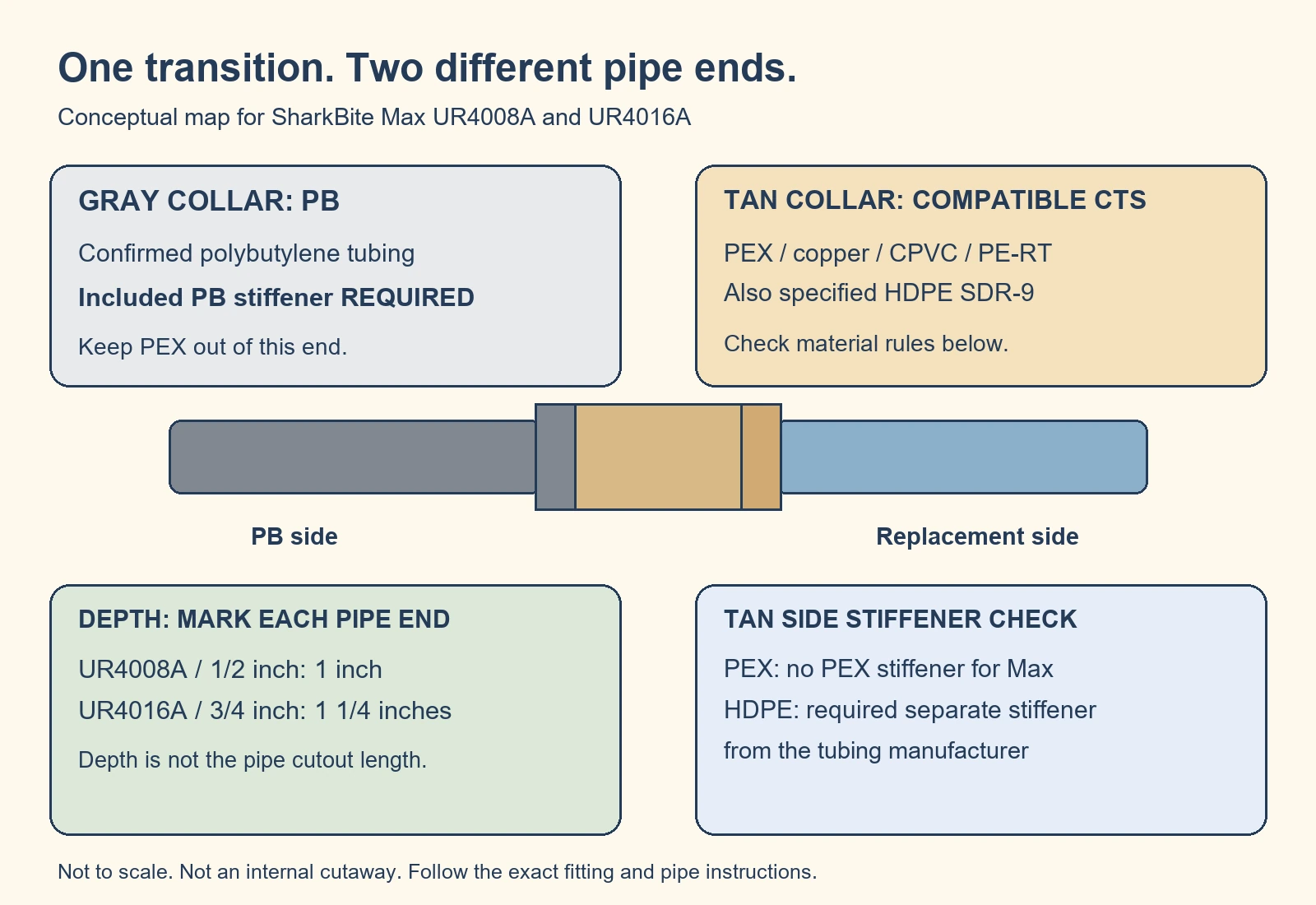
Gray end: PB and its included stiffener
The PB connection requires the tube stiffener supplied with this fitting. The Max design’s general statement about needing no PEX liner does not cancel that requirement. Check the exact PB instructions and the supplied components before cutting pipe.
If the required PB stiffener is absent, stop and resolve that with the supplier or manufacturer. Do not borrow a liner from a different fitting family. Its apparent ability to slide inside the tubing does not establish compatibility.
Also keep PEX out of the gray end. Buying a transition with PB compatibility does not make both sides universal. Identify the end assignments while the fitting is still in its package, rather than under a sink after cutting.
Tan end: the listed CTS material
The documented tan side accepts compatible PEX, copper, CPVC, PE-RT, or HDPE SDR-9 tubing. For PEX, this Max connection does not require a PEX stiffener. That is a Max instruction, not a rule for every older push fitting.
HDPE is a separate exception: it requires the specified stiffener supplied by the tubing manufacturer. “No liner for PEX” does not mean “no liner for every plastic.” Nor does the HDPE permission extend to every black plastic water service line.
The PB adapter specification sheet puts these stiffener requirements beside the insertion depths. Keep that specialty sheet with the general installation guide. Read them together, rather than applying a generic PEX instruction to the PB end.
| Question | PB side | Replacement side |
|---|---|---|
| Which collar? | Gray | Tan |
| Which material? | Confirmed PB | One of the documented compatible CTS materials |
| Which stiffener? | Included PB stiffener required | None for PEX in this Max fitting; separate maker specified stiffener for HDPE |
| Which depth? | Depth for the exact fitting size | Depth for the exact fitting size |
Can you use ordinary SharkBite or PEX fittings on PB?
An ordinary UR008A Max coupling is not a substitute for UR4008A. Its general material list does not include PB. Similar packaging, a shared nominal size, and the same brass color do not change that boundary.
Read the product name for an explicit PB transition, then confirm the model number. Do not shorten the shopping request to “a SharkBite.” A brand sells several connection systems with different pipe permissions.
Likewise, a PEX barb, expansion fitting, or clamp arrangement needs approval for its actual pipe and connection method. Do not assume a PB tube can replace PEX on the same barb. The fact that a tool closes a ring does not prove that the joint is specified correctly.
What about PEX crimp rings on polybutylene pipe?
Do not treat this as a universal yes or no about the tool alone. A crimp transition is a complete assembly: fitting end, tubing, specified ring, tool, and inspection method. Each must match the particular system.
Manufacturer catalogs distinguish PB transition fittings with their PB ring from ordinary PEX fittings. That distinction is enough to reject a loose recipe assembled from spare PEX parts. It is not enough to prescribe every crimp ring or tool for every legacy PB connection.
If choosing a crimp alternative, request the current instructions for that exact transition and both sides of the joint. Have the supplier identify the required rings and compatible tool. An answer that names only the tool, without the fitting and ring, leaves the question unresolved.
The two Max models discussed here make their push connections without a crimp tool. Buying rings for them adds no missing installation step. Pipe preparation, depth marking, and the PB stiffener remain necessary.
Insertion depth: mark each end before assembly
The documented Max depth is 1 inch for the 1/2 inch transition. It is 1 1/4 inches for the 3/4 inch transition. These measurements run from the prepared pipe end along the pipe, separately for both connections.
Use the stated insertion depth, not half the fitting’s overall length. An outside drawing dimension is not automatically a pipe engagement measurement. In particular, a rounded dimension on a drawing should not replace the dedicated insertion table.
Marking the pipe gives you an external reference for a connection hidden inside the body. A fitting can hold the tube before it reaches its final position. “It won’t pull out” is therefore a different observation from “it reached the specified depth.”
Older push fittings may require different marks. Keep the exact model, generation, and instruction sheet together. A familiar number remembered from another repair is not a reason to ignore the supplied guide.
For a hypothetical 3/4 inch transition, label both prepared ends at 1 1/4 inches before joining either side. After assembly, check each mark against its own collar. Seeing the replacement side seated does not verify the hidden PB side.
Plan the space before removing any pipe
Insertion depth tells you how much pipe engages the socket. It does not, by itself, tell you how much old pipe to cut out. The repair layout also needs the actual fitting dimensions and room to assemble the chosen arrangement.
Two fixed ends cannot necessarily move enough for a standard coupling. Do not create that movement by pulling old PB against another concealed joint. Have a plumber choose a repair layout when the route is tight, brittle, or restrained.
Measure available straight pipe and access for preparation, marking, and inspection. A location that admits the fitting body may still prevent a clean cut or a view of the depth mark. Those are practical reasons to move the transition, rather than force the smallest possible patch.
Checks before a local PB transition is installed
This is a preparation and inspection framework for the documented fittings. It does not replace their installation instructions or a plumber’s assessment of the remaining PB. Keep the work exposed until the specified checks and any required inspection are complete.
- Establish a working shutoff. Isolate the water supply and relieve pressure before cutting. If the valve does not stop the water, resolve that first.
- Confirm the exact materials and sizes. Record both pipe ends, the model, and the required stiffeners. Check local installation requirements for the proposed repair.
- Inspect the pipe that must remain. The connection needs round, clean, undamaged pipe. A crack, gouge, distorted end, or damaged sealing area is a reason to stop and reassess.
- Prepare the ends using the correct pipe tools. Follow the instructions for square cuts and removal of burrs or debris. Avoid treating old tubing as a handle while working.
- Confirm orientation and mark the depths. Keep gray for PB and tan for the compatible replacement tube. Verify the included PB stiffener requirement before engagement.
- Assemble and inspect both connections. Follow the manufacturer’s process to full insertion. Check both depth marks, not just the easier side.
- Restore water and check the repair. Follow the applicable test and inspection requirements. Stop if any connection leaks; a brief dry surface is not proof that old PB elsewhere is sound.
The Max installation guide linked from the product page provides preparation and connection instructions. Use the specialty PB sheet alongside it for the PB stiffener. A general material list that omits PB does not erase the specialty adapter’s end specific rules.
When the fitting choice is the wrong first question
If several old joints have leaked, ask for an assessment of the remaining piping. A transition changes the connection at its own location. It neither renews the material upstream nor establishes a service life for the rest of the home.
Similarly, a fitting’s advertised pressure capability is not a safe test pressure for an old PB system. The installed piping and every other component have their own limits. Leave test conditions to the applicable instructions and qualified assessment.
Call for help when pipe crumbles, cracks during preparation, or lacks a sound area for the seal. Stop if access would require pulling on hidden joints. Uncertain material identification is another reason to pause before ordering parts.
For a leak beneath a manufactured home, also identify what became wet before closing the access. Restoring water service and addressing wet surrounding materials are separate jobs. Do not seal the repair out of view while the leak’s extent remains unclear.
A sensible repair discussion separates immediate water control from the longer piping decision. Ask what will remain PB, how it was assessed, and what further work is recommended. That makes the limitation visible without pretending every isolated leak requires the same project.
What if the connection will be hidden or underground?
The product page lists concealed and underground applications, with wrapping required for burial. That permission belongs to an installation system with conditions. It is not a blanket approval of the existing PB or of every location beneath a home.
Distinguish a connection inside a wall from one touching soil. Burial protection, soil conditions, pipe support, and local requirements need their own review. Covering a fitting with insulation does not automatically satisfy the manufacturer’s burial instructions.
Before concealing the repair, ask the installer which instructions cover that location and how inspection will be completed. Keep a record of the exact fitting and the materials joined. Photographs of both depth marks are useful documentation, although they cannot replace a required test or inspection.
If an unresolved leak remains, keep the water isolated and arrange assessment. Do not treat concealment approval as permission to cover a questionable connection. Choosing a fitting and deciding that a finished repair may be closed are separate decisions.
A purchasing checklist for polybutylene pipe fittings
Bring a short connection record to the supplier. It is more useful than a shopping list containing only diameter and brand. Fill the record before cutting, while markings and the original layout remain available.
- Existing pipe: material marking, nominal size, measured outside diameter, and clear photographs.
- New pipe: exact material, size, and applicable tubing identification.
- Connection pair: PB to the named replacement material, with any intended size change shown separately.
- Exact adapter: model and package description, plus its current specialty sheet.
- Required components: included PB stiffener and any separate material specific requirements on the opposite end.
- Access: straight pipe available, room for assembly, and a way to inspect both depth marks.
- Repair boundary: what old pipe will remain and who will assess or install the repair.
UR4008A and UR4016A are technical examples within those limits. They are not a recommendation to patch every PB system or buy before identification.
Remaining fit questions
Can one transition join PB to PB?
These two models provide one PB end and one compatible CTS end. They do not specify PB at both ends. Replacing a short section between two retained PB ends needs a separately planned arrangement, rather than reversing one transition.
What if the old tube measures 1/2 inch outside?
Do not buy the nominal 1/2 inch model from that measurement alone. Its CTS reference is 5/8 inch outside diameter. Have the existing tube identified; a smaller legacy connection is outside the two model selections in this guide.
Can glue or tape correct the wrong connection?
These push transitions make their seal through the specified pipe engagement and internal seal. Glue or tape is not a substitute for the right material, sound pipe, required stiffener, or full insertion. Resolve the mismatch instead of adding an improvised sealing layer.
Does a removable fitting mean repeated trial assembly is harmless?
No. The installation guide requires inspection after removal and describes fittings as permanent connections, rather than parts for repeated assembly cycles. Use the appropriate disconnect equipment and instructions; damaged pipe or a damaged fitting needs reassessment.
The useful endpoint is a verified connection plan: identified PB, a compatible transition, correct end assignments, and sound pipe to receive it. Good polybutylene pipe fittings solve a specified connection problem. The condition of the remaining system still deserves its own decision.
Found a detail that needs checking? Tell us about a correction.