
A mobile home crossover duct connects air distribution ducts in different sections of a manufactured home. Before buying a replacement, confirm its route, inside diameter, exterior listing and insulation requirements. A tube that fits the old collars can still be wrong for the system.
If one section suddenly loses airflow, inspect that connection before assuming the furnace or air conditioner needs replacement. Treat the room pattern as a clue. A blocked trunk, poor return path or equipment problem can produce overlapping symptoms.
What the mobile home crossover duct actually connects
In a typical floor duct arrangement, each home section has a long supply trunk. A crossover lets conditioned air reach the trunk across the joining line. Some arrangements use more than one connecting run.
That does not make every large tube beneath a home a crossover. An outdoor packaged unit can have separate supply and return connections. Identify where each end goes before ordering anything.
Crossovers can also be built into a floor or ceiling connection. An exposed loop beneath the home is one arrangement, not a universal layout. Missing that distinction can lead someone to cut sound belly material while searching in the wrong place.
Start with the home installation instructions and equipment information. For the rest of the air distribution system, see our guide to tracing mobile home supply and return airflow. This article focuses on selecting and restoring the connection between sections.
Find the problem before choosing replacement duct
Write down which rooms changed and when. Compare several affected registers with several working ones during the same operating cycle. Keep furniture and rugs clear of the openings.
Record whether the change was sudden, gradual or present since installation. Note recent work beneath the home, animal entry, flooding or equipment replacement. These details help an installer distinguish damage from a longstanding design problem.
| What you notice | What to investigate | What it does not establish |
|---|---|---|
| Most registers in one section became weak together | Its crossover, both collars and the receiving trunk | That a new tube alone will restore delivery |
| Airflow is weak throughout the home | Filter, equipment and the full supply and return paths | That the crossover is the only restriction |
| One room changes when its door closes | The room’s return pathway and branch connection | That a larger crossover is required |
| The tube repeatedly pulls off the same end | Core attachment, collar condition, routing and support | That wrapping the outside again is a lasting repair |
| The outside sleeve looks intact but delivery stays poor | The concealed core, compression, bends and downstream duct | That the air carrying layer is connected |
A hand over a register gives a rough comparison, not an airflow measurement. Do not use that impression to select a diameter. A technician can check delivery and system pressure against the actual equipment and design.
If the filter is overdue, address it according to the equipment instructions. Our furnace filter identification guide explains the fit information to collect. Do not compensate for a blocked system by closing registers throughout the working section.
Inspect access before entering the space
Photographs from an accessible opening may be enough to start a service request. Do not enter standing water, exposed wiring, animal contamination or an area with unstable supports. Never move a pier, brace, anchor or structural member to create duct clearance.
Shut equipment down before anyone handles its ducts. Leave internal equipment access, electrical isolation and operating tests to the technician where required. If you cannot trace the route safely, request photographs as part of the inspection.
Separate the core, insulation and outer jacket
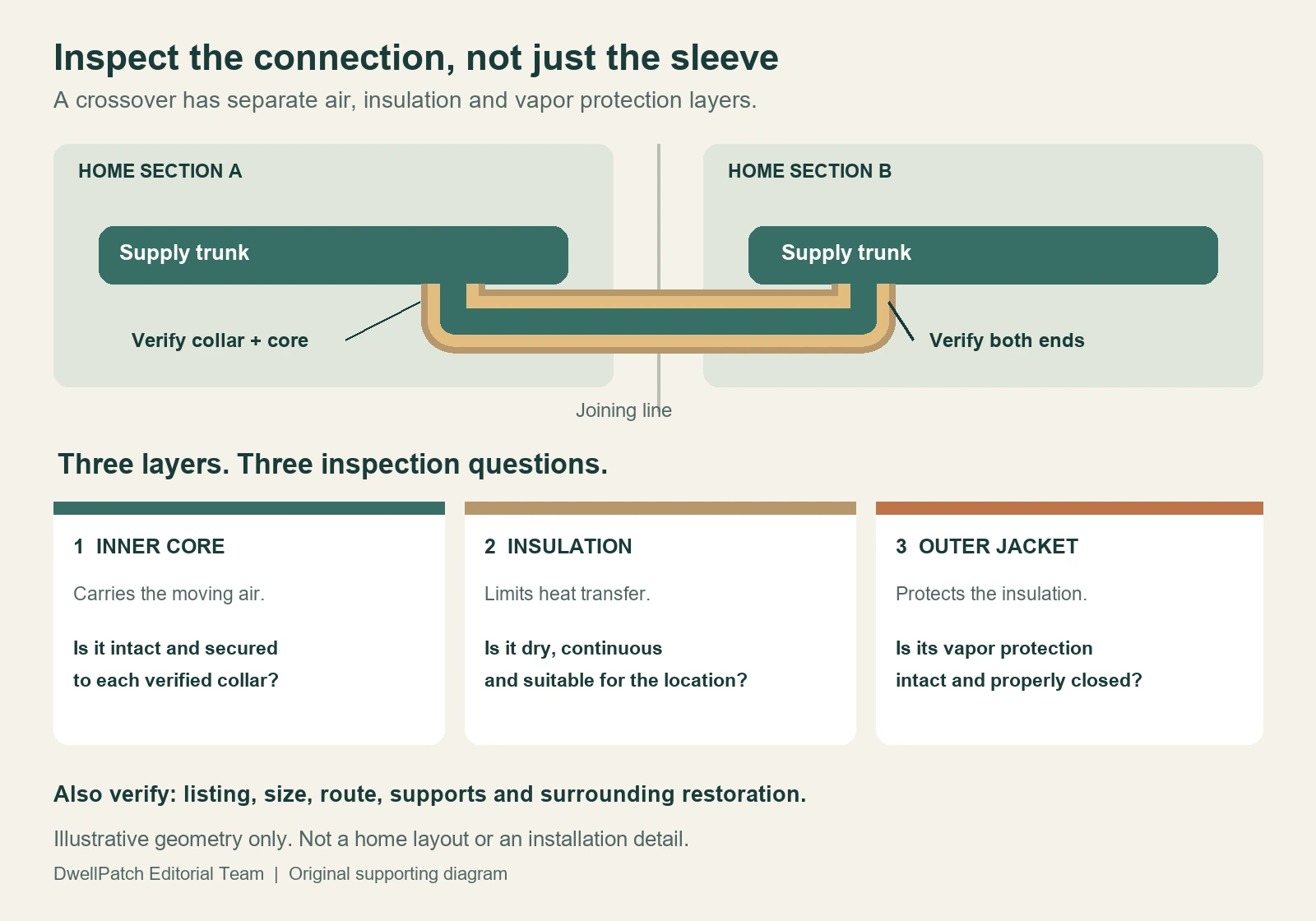
An insulated flexible duct has three jobs layered together. The inner core carries air. Insulation limits heat transfer, while the outer jacket protects the insulation and controls vapor entry.
A tight outer sleeve does not prove the inner core is attached. Conversely, air can move through an intact core while damaged insulation or jacket needs separate attention. Ask which layer failed before agreeing to a patch.
This makes inspection at both ends essential. The technician should identify the core attachment beneath the insulation, the condition of each collar and the outer closure. A photograph of tape on the outside answers only part of that question.
The diagram separates these inspection points. Its shape is illustrative. It does not locate the crossover in your home or prescribe a fastening detail.
How to choose the correct replacement
Choose a mobile home crossover duct from a written specification, not a photograph or the home’s width. The useful specification combines physical fit with the intended operating conditions. Keep the label and installation instructions available for the installer.
Confirm the inside diameter and both connection ends
Record the nominal duct diameter from a readable label or approved home documentation. Have the installer verify both metal connection points. Measuring around the padded outside jacket does not tell you the air passage diameter.
Do not assume a previously installed size was correct. This matters after an equipment change, an undocumented reducer or repeated weak delivery. Those situations call for design review rather than copying the existing tube.
There is no reliable universal diameter based only on single, double or triple section construction. A home section can serve different loads through different routes. The selected run must work with its fittings and available system pressure.
Specify a listed air duct for its location
Read the product designation itself. Flexible air ducts and flexible air connectors are distinct listed products. Neither a black jacket nor the phrase mobile home proves exterior suitability.
Under the manufactured housing circulating air standard, exterior connections cannot use air connectors. Exposed ducts beneath the home must be listed for exterior use. Ask for the applicable product documentation rather than relying on a store category.
Keep dryer exhaust tubing, plumbing pipe and unverified foil tubing out of the comparison. They are not interchangeable because their diameters look similar. Our parts compatibility guide explains why a familiar product label does not settle the intended application.
Verify insulation and the vapor retarder
The current construction standard specifies minimum R8 insulation for the exposed ducts described in its outside air provision. It also requires a continuous vapor retarder with a rating no greater than one perm. Its basement exception and exposure conditions matter.
That is not a claim that every duct anywhere inside every existing home needs the same replacement. For an older home, ask which repair rules apply locally. Have the installer reconcile those rules with the home’s instructions and the selected product.
Write the required insulation value into the quote. Do not accept a lower value merely because a retailer stocks it or an older tube used it. Keep the label photograph with the job record.
Measure the route rather than buying by package length
The installed path needs room for bends, connections and support without stretching against the collars. Excess duct left coiled or compressed also creates problems. Package length is a purchasing quantity, not an instruction to use every foot.
Ask the installer to document the proposed route before cutting. If an obstacle requires a sharp turn, compare an appropriate fitting or another approved route. Do not notch a structural member to make a preferred product fit.
Changing from flexible duct to rigid metal needs a fresh review of fittings, pressure losses, insulation and support. The Air Duct Council’s technical guidance explains why equal diameters do not guarantee equal performance. Neither automatic upsizing nor automatic size matching is a complete design method.
A specification sheet to send with the quote request
Use this record before comparing products or bids. Leave unknown fields marked unknown. An unanswered compatibility question is more useful than an invented measurement.
| Record | What to supply or request | Why it changes the purchase |
|---|---|---|
| Home and equipment identity | Manufacturer, model, available installation instructions and equipment model | Connects the work to the actual system |
| Function and route | Which ducts it joins, number of runs and proposed path | Avoids confusing a supply crossover with an equipment return |
| Connection details | Verified nominal size at both ends and collar condition | Reveals needed fittings or repair beyond the tube |
| Product identity | Manufacturer, exact model, listing, insulation value and instructions | Allows a real compatibility check before purchase |
| Support plan | Attachment locations, suitable supports and ground clearance | Prevents the new connection from inheriting the old failure |
| Related damage | Water, animals, missing insulation and opened bottom closure | Separates the duct work from surrounding restoration |
| Completion evidence | Photographs, recorded checks and any remaining limitation | Defines what a finished job includes |
For example, a quote reading replace crossover leaves several choices unresolved. Ask it to name the product, both end treatments and the support work. That turns an uncertain allowance into a scope you can compare.
If one bidder includes collar replacement and another excludes it, the totals describe different jobs. Request the reason for that difference. Do not assume the lower number represents the same finished result.
When reconnection is enough and when replacement makes sense
A sound duct that slipped off may be reusable after inspection. The repair still needs an approved core connection, proper sealing, restored insulation and a secure outer closure. Correct the load or routing that helped pull it loose.
A damaged jacket is a different repair from a punctured core. Manufacturer instructions distinguish these conditions. Do not cover both with the same promise that more tape will fix it.
| Confirmed condition | Reasonable scope to evaluate | Question that prevents a repeat failure |
|---|---|---|
| Sound duct detached from a sound collar | Approved reconnection with restored insulation and jacket | Why did the attachment fail or carry too much load? |
| Localized outer jacket tear, dry insulation and intact core | Manufacturer permitted jacket repair | Has the source of abrasion or animal access been addressed? |
| Penetrated core or crushed wire structure | Replacement or a specifically permitted connection repair | Will a patch preserve the designed air passage? |
| Wet, contaminated or badly deteriorated insulation | Material replacement and moisture investigation | What caused the water entry or condensation? |
| Broken or loose collar at the trunk | Collar and trunk repair before reconnecting the run | Will the supporting duct remain airtight and secure? |
Wet or visibly moldy fiberglass duct insulation needs qualified assessment and replacement rather than fragrance or paint. Correct the moisture source too. Do not identify mold species from color or a photograph.
Likewise, sealing a large disconnection is a physical repair first. A service intended to seal small leaks does not restore a missing connection or crushed run. Ask what defects require access and replacement before considering any whole system treatment.
What a proper installation scope includes
The federal installation provisions for duct connections require sealed joints, appropriate support and compliance with duct manufacturer instructions. They also recognize floor and ceiling crossovers. These initial installation provisions are not a blanket approval for any alteration to an older home.
Use the following as a scope discussion with the installer. It is not a universal assembly recipe. Exact closure materials, fasteners, cure conditions and connection geometry come from the applicable instructions.
- Confirm the receiving structure. Check both collars and adjacent trunks before attaching the replacement. A new run cannot compensate for a loose fitting hidden above it.
- Restore the air carrying connection. Inspect and secure the inner core using the permitted closure system. Finish the insulation and jacket as separate layers.
- Route and support the assembly. Keep it above ground, with suitable supports that avoid squeezing the air passage or insulation. Check bends and contact with surrounding services.
- Finish the surrounding enclosure. Repair any opened bottom closure with the appropriate system. Keep that work separate from sealing the duct itself.
- Verify operation and document the result. Check the repaired path and delivery to affected rooms. Record unresolved airflow, moisture or equipment concerns before the job closes.
Do not transfer screw instructions for a metal duct to a nonmetallic flexible core. The Air Duct Council specifically cautions that screws can damage some nonmetallic products. Have the installer identify the permitted fastening method for the actual duct.
General cloth utility tape is not a substitute for a specified duct closure. Even a listed tape must suit the material and application. The product label, instructions and complete joint matter more than its color.
If access opens the enclosing belly layer, include restoration in the scope. Our underbelly repair planning guide covers that separate assembly. Do not leave the enclosure open simply because the airflow has returned.
Compare total repair costs without a false national price
A mobile home crossover duct price is only one part of a completed job. The total can include fittings, closure materials, supports, access and removal. Damaged collars, contamination or surrounding insulation add different work.
Request a written breakdown with the same scope from each bidder. Ask whether the quoted duct meets the agreed listing and insulation requirements. Confirm who supplies missing fittings and who restores any opened enclosure.
Record these items separately: diagnostic visit, duct assembly, collar repairs, support work, related restoration and verification. Ask which items are firm and which depend on opening the area. Request approval before additional work changes the price.
There is no dependable total for your home without those facts. An online tube price cannot establish labor or access costs. Nor can another home’s energy savings predict your payback.
Check the result before closing the job
Ask for photographs of both completed ends and the full supported route. The installer should confirm the hidden core connection before its outer covering conceals it. Keep the product label and installation record with those pictures.
Request airflow checks after repair, including the previously weak section. Where relevant, ask for system pressure and supply and return balance evaluation against equipment requirements. Duct changes around fuel burning equipment also warrant appropriate combustion safety checks.
Compare room conditions under reasonably similar operation. A comfortable day alone does not prove a hidden joint is secure. If the original symptom remains, reopen the diagnostic question rather than adding another tube without evidence.
Persistent problems may involve the receiving trunk, return paths, equipment or building enclosure. Our whole system heating and cooling guide helps frame that broader review. Keep the crossover repair record so the next technician knows what was actually checked.
Questions that come up before ordering
Can I order the same diameter as the old duct?
Use the old label as evidence, then verify it against the home and equipment information. Prior alterations may have used an unsuitable size. Have both connection ends and the required airflow checked before treating a matching diameter as approval.
Does a single section home have a crossover?
It has no second home section for an interconnecting crossover of this type. It may still have exposed ducts linking an outdoor unit to its supply and return system. Describe the actual route to a supplier rather than relying on the nickname.
Why does the duct keep falling off?
Repeated detachment calls for inspection of the core attachment, collar, support and routing. A sound outer jacket can conceal a failed inner connection. Rewrapping the visible sleeve alone does not address every possible cause.
Should I replace it with a larger one to improve airflow?
Only if a system review supports that change. Diameter, length, fittings and equipment pressure work together. A replacement decision should name the cause of weak delivery and explain how the proposed assembly addresses it.
Found a detail that needs checking? Tell us about a correction.