
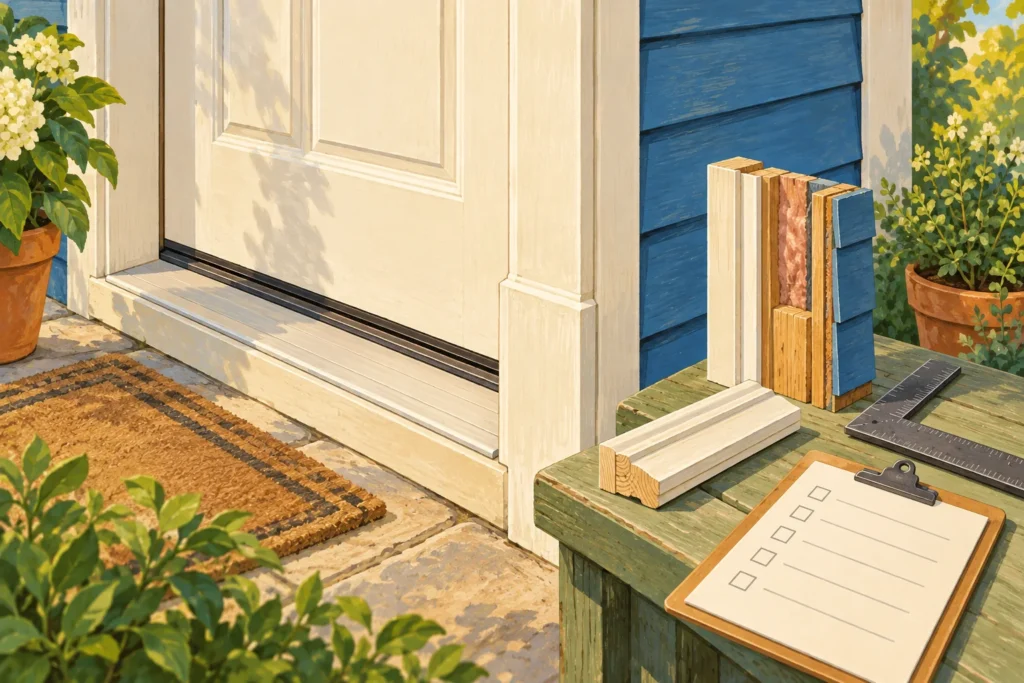
Mobile home door frames may need repair or replacement when damage affects support, alignment, or seal contact. Loose decorative molding alone calls for a different repair. Before ordering anything, identify whether the damaged part is trim, a jamb, the complete door assembly, or the wall framing behind it.
For a wider opening project, start with the doors and windows planning overview.
That distinction can save you from buying a door you don’t need. It also prevents a cosmetic patch from hiding damage that a replacement door cannot fix.
What mobile home door frames include
The frame surrounds the moving door panel, also called the slab. Its upright sides are the jambs, and its top member is the head jamb. On an exterior assembly, the bottom sill or threshold forms another important connection.
The hinge jamb carries the hinges. The strike jamb receives the latch and, where fitted, the deadbolt. Trim covers the transition between the installed frame and the wall finish.
| Part | Where to look | What a problem here means |
|---|---|---|
| Casing or molding | The decorative border on the wall face. | A loose border may need trim work. It does not establish that the jamb has failed. |
| Side jamb | The upright surface beside the slab. | Damage can affect hinges, the latch, alignment, and weatherstrip attachment. |
| Head jamb | The frame member across the top. | Distortion or deterioration needs assessment alongside the side jambs and opening. |
| Stop and weatherstrip | The contact area where the closed slab meets its seal. | A sealing problem may be repairable without replacing the frame. |
| Sill or threshold | The bottom of the exterior door assembly. | Check its condition and support. A water problem here may extend beyond the visible frame. |
| Rough opening framing | The wall structure surrounding the installed assembly, usually concealed. | This is a separate repair scope. New molding or a new jamb cannot establish its condition. |
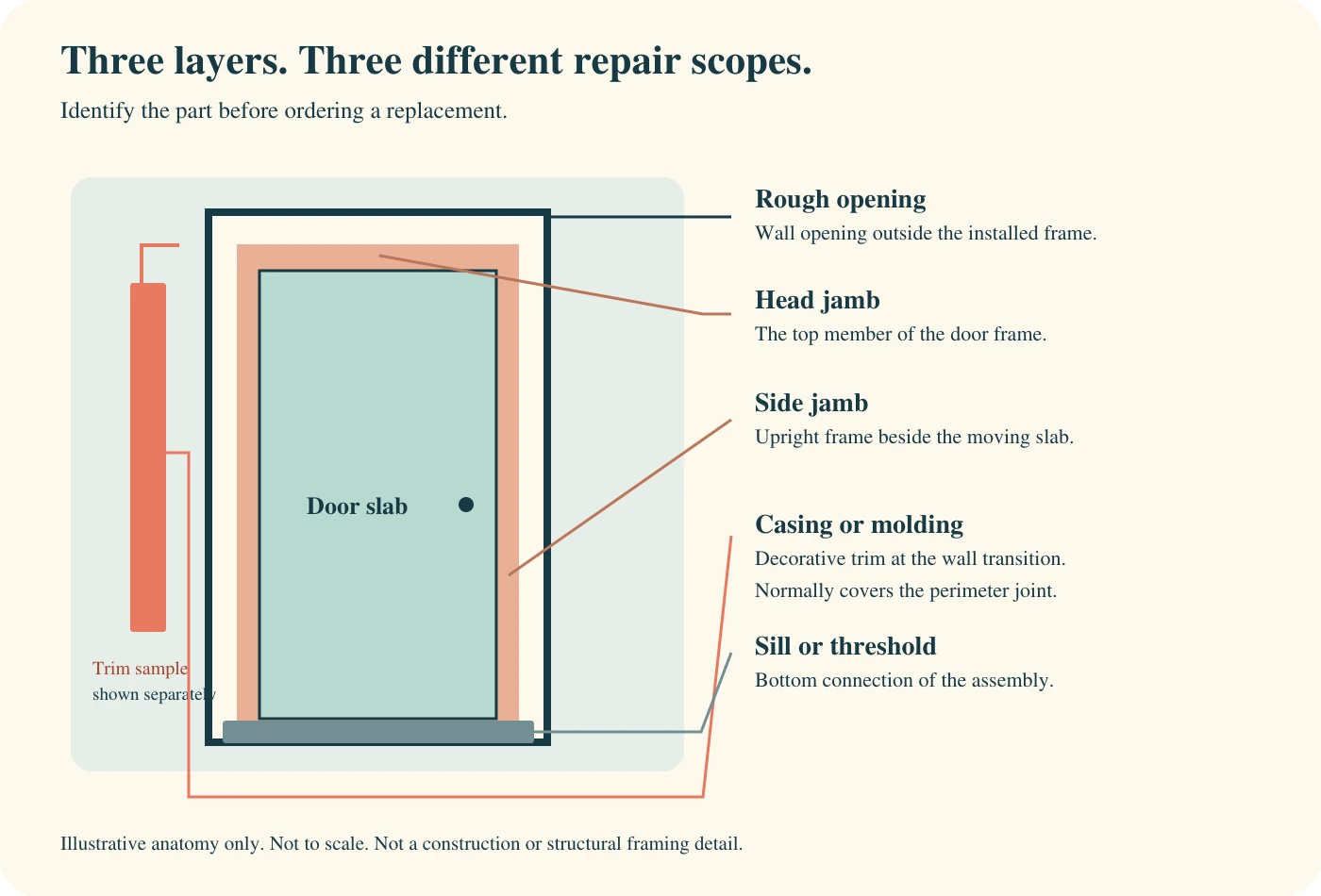
The rough opening is the framed space in the wall that receives the door assembly. It is not the same measurement as the slab. A gap between that framing and the jamb can be part of the installation design.
Names can overlap in listings. A seller might use “door frame” for a complete entry assembly, individual jamb pieces, decorative casing, or a storm door frame. Ask for a drawing and an itemized contents list rather than relying on the category name.
Entry frames and storm door frames are separate questions
A combination unit has an entry door and an outer storm door, with connections specific to that assembly. The frame supporting the storm door is not automatically the same component as the entry jamb. Identify which door rubs, which hinge is loose, and which frame has damage.
For example, an outer closer bracket can be damaged while the entry door still works properly. Conversely, a smooth operating storm door tells you little about the wood or floor beneath the entry threshold. Photograph both doors separately when requesting parts.
Elixir’s current door document library separates regular outswing, combination, and brickmold installation resources. Use the document for the identified assembly. A familiar brand name alone does not establish that two frames share the same construction.
Inspect the condition without turning it into demolition
Start with the door installed and the opening weather protected. Keep a phone, tape measure, flashlight, and notepad nearby. You can gather useful evidence before disturbing trim or removing a single fastener.
Stop using a damaged door if its slab or frame appears unstable. Arrange prompt repair when it cannot close, latch, or provide a usable exit. Do not rely on a closer or lock to hold a failing assembly together.
1. Record what moves
Open and close the entry door slowly without slamming it. Note where it catches and whether lifting or pushing the slab changes the symptom. Record whether the latch engages with normal pressure.
Watch the hinge attachment and the surrounding jamb as the door moves. Movement at a hinge is different from movement of the whole frame relative to the wall. Describe the observation rather than immediately naming a cause.
Repeat the observation with the storm door, if present. Keep the two sets of symptoms separate. A shared doorway can still contain two different repair problems.
2. Compare the gaps around the slab
Look at the visible clearance across the top and down each side. Write down where it narrows, widens, or disappears. Take a straight photograph instead of relying on a close angled picture.
An uneven gap warrants investigation, but it does not diagnose rot, settling, or a bad hinge by itself. The frame may have been installed out of alignment. The slab, fasteners, underlying opening, or home support may also need assessment.
A level can document whether an accessible jamb is vertical and the head or threshold is level. Comparing diagonals helps assess squareness when you can identify matching measurement points. These are observations, not permission to pull the frame into a new position.
Use the manufacturer illustration of plumb, level, and square to understand those checks. Its geometry is useful here; its dimensions or installation details do not establish fit for another door system.
3. Examine the lower corners and threshold
Look for peeling finishes, staining, swollen material, open joints, corrosion, and obvious deterioration. Check the visible floor beside the threshold. Record any soft feeling underfoot without repeatedly loading a suspect area.
A dark mark alone cannot identify the depth or cause of damage. Likewise, a clean painted surface cannot confirm that the concealed opening is sound. If material is visibly crumbling or the threshold moves, arrange an inspection before covering it.
Take pictures outside and inside at the same corner. Include the nearby siding, landing, and wall rather than only the damaged spot. That context helps an installer investigate how water reaches the doorway.
4. Note when the problem changes
Does the door bind all the time, only after rain, or after recent work? Did several doors or windows change together? Has this frame already been patched or repeatedly adjusted?
These details help decide what to inspect next. They do not prove that the home needs leveling. Ask a qualified manufactured housing professional to assess a suspected support problem before anyone adjusts supports or cuts the opening.
Elixir’s installation instructions explicitly connect door operation with the home’s setup and support. They also warn against adjusting a racked door before final setup. Repeated alignment trouble deserves a broader assessment than another trim repair.
Repair trim, repair the jamb, or replace the assembly?
Choose the repair boundary from the condition and the available compatible parts. A damaged piece is not automatically a reason to replace everything. Keeping an old slab is not automatically the least expensive complete repair either.
| What you find | Reasonable next step | What must be checked first |
|---|---|---|
| Loose or chipped casing; door works normally. | Investigate a trim repair. | Confirm the jamb is stable and the surrounding surface is sound. |
| Worn weatherstrip; frame is firm and the slab aligns. | Identify a compatible replacement seal. | Match the attachment and profile. Extra thickness must not obstruct closure. |
| Localized damage to a jamb member. | Ask about an approved component repair. | Determine the damage depth, anchoring condition, and exact replacement geometry. |
| Split material at a hinge or strike; attachment is insecure. | Arrange a jamb and anchorage assessment. | Confirm whether a repair can restore the required attachment. Cosmetic filler does not answer that question. |
| Widespread frame deterioration or distortion. | Compare a complete assembly with a frame rebuild. | Inspect the opening and threshold support before selecting either route. |
| Soft floor, damaged concealed framing, or recurrent water entry. | Define the opening and water management repair first. | Establish the extent of damage before closing the wall or finalizing the door order. |
| Several openings bind or adjustments keep failing. | Have the home and openings assessed together. | Resolve the cause before resizing a door or changing frame alignment. |
When trim work is enough
Decorative casing bridges the visual transition between the frame and wall. If that is the only failed part, replacing it need not change the door assembly. First establish that the material beneath it is sound and that no leak is being concealed.
Choose replacement molding by its location, exposure, profile, and attachment requirements. Interior decorative molding and an exterior door surround have different jobs. A wider border may cover an old paint line, but it cannot repair a loose jamb.
Keep a usable sample or clear profile photograph when trying to match existing trim. Record the width and thickness separately. A similar face pattern can still leave an awkward transition if the thickness differs.
When a jamb repair deserves consideration
A component repair can make sense when damage is limited and the remaining system is serviceable. It also requires a compatible part and a supported repair method. Have the installer explain both before agreeing to preserve the slab.
A replacement jamb leg must work with more than the opening’s height. Its stop, weatherstrip attachment, hinge preparation, strike location, and threshold connection all matter. A board with the same outside dimensions is not necessarily a replacement jamb.
Where hinges or locks attach, ask how the repair restores sound attachment. A patch that looks smooth after painting has not demonstrated that. Do not treat filler, a cover plate, or trim adhesive as proof of restored door support or security.
When a complete assembly is the clearer route
Compare a complete unit when multiple frame members are damaged, the slab also needs replacement, or compatible components cannot be confirmed. It gives the installer a defined door and frame combination. It still needs a sound, correctly prepared opening.
Request the same finished scope for both options. A cheap jamb quote can become expensive after hinge fitting, threshold work, weatherstrip matching, and finish repairs. A complete unit quote can also omit those surrounding repairs.
Ask what remains from the existing assembly in each proposal. “Replace frame” is too vague when one proposal retains the sill and another replaces it. Written component lists make the comparison meaningful.
Find replacement mobile home door frames that actually match
Begin with the original door maker, a distributor familiar with that product, or a supplier who can identify it from documentation. Ask whether the needed component is sold separately. Do not assume a frame listed under manufactured housing fits every manufactured home door.
Look for a readable label, order record, series number, or identifying mark. Photograph it before cleaning or refinishing the area. Include the full doorway and hinge arrangement with your request.
If identification fails, ask the installer to document the existing assembly and proposed replacement. Do not order a near match simply because the door width sounds familiar. The unresolved connections are often where a component repair becomes impractical.
Give the supplier a compatibility packet
- Door identity: manufacturer, series, label details, and any old order information.
- Assembly type: entry door alone or combination entry and storm door, with photographs of each.
- Movement: which way each door opens, plus a photograph showing its hinges from outside.
- Damage boundary: casing, hinge jamb, strike jamb, head, sill, or concealed opening under investigation.
- Measurements: clearly labeled slab, frame, opening, and depth measurements that you can actually verify.
- Connections: close photographs of hinges, strikes, weatherstrip attachment, and the sill to jamb junction.
- Finished wall: inside and outside surfaces, including any added paneling, siding, or trim.
Ask the supplier to identify each required measurement on its own drawing. Do not send an unlabeled list of numbers. If a measurement remains concealed, say so rather than estimating it as confirmed.
Jamb depth is separate from door width
Door width runs across the doorway. Jamb depth concerns the frame’s extent through the wall. Neither dimension substitutes for the other.
The current Elixir combination door order form illustrates why a single depth assumption fails. It lists PVC jamb options of 4, 4 1/2, and 6 1/2 inches, with configuration limits. Those are options for that product family, not a table assigning every home to a depth.
Have the supplier show the reference faces for its jamb measurement. Added wall finishes may complicate how existing trim meets a new frame. Do not infer the required depth from the home’s age or a guessed stud size.
Do not convert a nominal size into an opening by guesswork
The advertised size, slab size, frame size, and required rough opening can differ. Use the exact product’s current sizing chart. Do not add a generic allowance borrowed from another brand or door type.
Even a single manufacturer’s instructions can contain separate tables for different series. The Elixir combination instructions include call sizes whose listed rough openings are not identical to the advertised dimensions. Confirm the actual row for the proposed model before ordering.
Do not remove a functioning exterior assembly merely to obtain an ordering measurement. Plan any necessary exploratory work with the installer and a way to secure the opening. A confirmed identification and drawing may resolve the question without that disruption.
Choose frame materials by the complete system
Material is one selection factor, alongside profile, anchoring, exposure, and compatible parts. A frame described as vinyl, composite, wood, or metal still needs to match the intended door system. The material label alone cannot establish fit.
For wood components, check the required finish and maintenance, especially at exposed ends and joints. For composite or PVC components, check approved fasteners, installation details, and connections. For metal components, inspect the finish and condition as well as the profile.
Ask whether the material description applies to the whole jamb or only a facing or lower section. Also ask which other materials remain beneath the threshold and around the opening. A rot resistant frame cannot protect unrelated concealed wood from an unresolved leak.
Do not substitute decorative PVC trim for a jamb simply because both are white and resist moisture. Use a component intended for the actual role. Its fastening and door hardware details must be established.
Resolve water entry before closing the repair
Frame damage and a water source are separate findings. The damaged corner shows where deterioration is visible. It does not necessarily show where water first entered.
Have the installer inspect the head, side transitions, threshold, and adjacent wall as the repair allows. Ask whether the water management layers connect correctly around the opening. The visible bead along the trim is only one part of that discussion.
The Building America guidance on flashed openings explains the hidden damage risk and the role of drainage. Flashing must connect with the wall’s water protection layers. Sealing a visible crack does not establish that those concealed connections are correct.
Use the repair opportunity to document exposed conditions before they are covered. Photographs should show what was damaged, what was repaired, and how the opening was prepared. Keep those records with the replacement product information.
Do not prescribe caulk across every joint or fill every cavity with foam. Drainage details and sealing locations belong to the applicable assembly instructions. Sealants and insulation do not replace structural repairs or mechanical attachment.
Get a quote with a defined repair boundary
A useful quote tells you what the installer has confirmed and what remains concealed. Request separate descriptions for the door components and the surrounding opening. That makes surprises easier to understand if inspection reveals additional damage.
- Identify the existing problem. Request photographs and a description of the failed components rather than “bad frame.”
- List retained and replaced parts. Include the slab, jambs, sill, storm assembly, trim, seals, and hardware as applicable.
- Specify the replacement. Record the maker, series, configuration, depth, and confirmed sizing references.
- Describe opening repairs. Ask who assesses concealed damage and what would trigger a revised scope.
- Define water management and finishing. Include the applicable installation instructions and who completes the surrounding surfaces.
- Agree on final checks. The doors should operate, latch, and seal properly without being forced.
Avoid comparing a cosmetic trim price with a complete opening repair price. Ask for comparable written scopes first. The cost of access, damage repair, component fitting, and finish work depends on the actual doorway.
Before signing off, operate the entry door and storm door independently. Check for rubbing, visibly uneven gaps, loose components, and incomplete latch engagement. Ask the installer to explain any remaining issue and its resolution.
Keep the invoice, product labels, instructions, and condition photographs together. If trouble returns, these records help distinguish a component problem from a recurring opening or water issue. They are more useful than remembering that “the frame was replaced.”
Questions that come up before ordering
Can I buy just a mobile home exterior door jamb?
Possibly, but availability depends on the identified manufacturer, series, and component. Ask the maker or distributor to confirm the exact part. If it cannot be identified, compare a documented frame repair with a complete compatible assembly.
Can I keep the old door when replacing its frame?
Keeping it may be practical if the slab is sound and the replacement frame can accommodate its hinges, locks, seals, and sill connection. Have the installer confirm those details. A slab in good condition does not make a mismatched frame suitable.
Will wider molding cover a damaged frame?
It may cover the appearance, but it cannot restore the jamb or the opening behind it. Establish the damage boundary first. Use wider trim only as a finish choice after the necessary repair.
Does a rubbing door mean the frame needs replacement?
No. Rubbing is a symptom that needs diagnosis. Record the contact point and whether the jamb, hinges, slab, or entire opening moves before selecting a repair.
Are mobile home door frames interchangeable?
No universal match can be assumed. Check the exact assembly, dimensions, depth, hardware preparation, threshold, and weatherstrip connections. Confirm the installation instructions before placing the order.
Found a detail that needs checking? Tell us about a correction.