
Mobile home outlets can have a complete connection enclosure built into the device, or a conventional receptacle mounted in a separate electrical box. Those systems may look alike from the room. A replacement needs to match the wiring, mounting arrangement and required protection, not just the faceplate.
If you’re replacing an outlet because plugs fall out, plastic has darkened or power comes and goes, arrange an electrical assessment. Choosing a new device and finding the cause are separate tasks. A fresh outlet face doesn’t establish that the circuit behind it is sound.
Identify mobile home outlets before choosing replacements
The part you plug an appliance into is a receptacle. In everyday conversation, most owners call it an outlet. This guide concerns ordinary wall receptacles, rather than the larger connections serving ranges, dryers or the home’s supply.
The useful first distinction is the enclosure system. A self contained device combines the receptacle and its connection enclosure. A conventional receptacle relies on a separate approved box around its connections.
Both arrangements can appear in one home after repairs or remodeling. The home’s age, a rectangular cover or a store’s mobile home category cannot identify every installed device. Use existing records and visible markings first; leave hidden identification to an electrician.
| What you notice | Useful information | Still needs confirmation |
|---|---|---|
| A screwless or snap fitting plate | The cover may belong to a particular device family. | Enclosure type, exact model and whether the cover matches it. |
| A traditional duplex or rectangular decorator face | The replacement must accommodate the desired plug arrangement. | Mounting method, wire compatibility and protection requirements. |
| TEST and RESET buttons | The device has a protective function identified by its markings. | Whether it provides GFCI protection, AFCI protection or both. |
| Three openings for each plug | The face accepts a grounding type plug. | Whether a proper equipment grounding path actually exists. |
| A loose or cracked assembly | The device or its support needs assessment. | Whether the damage involves only the cover, the device or surrounding wall material. |
Don’t remove a plate or pull a receptacle forward just to finish a shopping list. An electrician can identify the assembly during a properly isolated inspection. Photograph the intact front and its location instead.
For problems involving several circuits or the home’s supply, start with the broader manufactured home electrical system guide. The outlet model is only one part of that system.
Self contained is a connection system, not a quality verdict
Self contained receptacles are designed as complete assemblies. Some use contacts that make connections through conductor insulation, with a specified installation tool. Their backs, cable openings and mounting parts are part of the system.
Hubbell’s Wirecon installation presentation demonstrates a dedicated tool and specific termination limits. That explains why pressing a replacement together with an improvised tool isn’t an equivalent method. It doesn’t establish that every self contained device follows that same procedure.
An ordinary receptacle with wire insertion holes is not automatically the same design. The phrase back wired also covers different terminal arrangements. Ask for the exact manufacturer instructions instead of relying on a nickname such as backstab.
Likewise, a device being listed for its intended use doesn’t approve every installation. Its permitted conductors, assembly method and mounting conditions still matter. A damaged device deserves investigation without treating every intact device of that style as defective.
Why matching the cover isn’t enough
A matching color and opening can conceal different backs or mounting brackets. A cover that appears to fit isn’t proof that parts from separate manufacturers form an approved assembly. Ask whether the proposed replacement includes every required part.
This matters when an old cover is unavailable or a mounting pawl has failed. The repair may require more than a new decorative plate. Don’t tape a loose device into place or use the plug to hold it against the wall.
Why conversion to a separate box needs a site check
A conventional box mounted receptacle may be a suitable replacement when the complete installation is designed for it. The electrician must verify usable space, enclosure capacity, cable entries, conductor condition and secure support. Those checks happen before the wall opening is changed.
A device that used continuous conductors may leave little practical freedom for a different connection arrangement. The number of cables and available conductor length also matter. Cutting wires first can remove options that existed before the conversion.
Tell the electrician if the wall is thin, recently covered or beside a cabinet. Our guide to identifying manufactured home walls helps describe the finish and project history. It doesn’t provide clearance to enlarge an electrical opening.
Build a replacement specification, not a cart of lookalikes
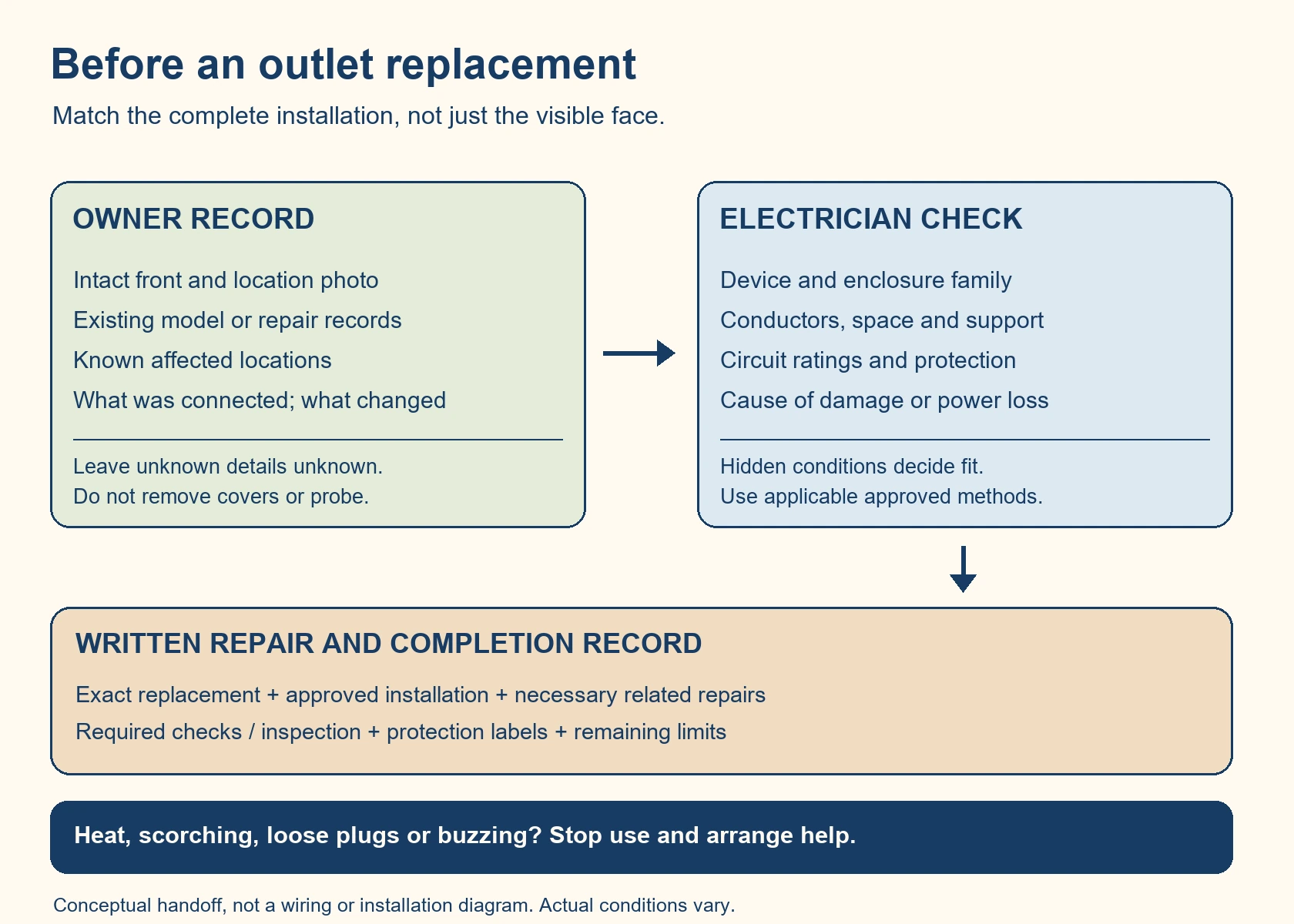
Before buying mobile home outlets, agree on who will verify the hidden details. The owner can supply records and explain the intended use. The electrician can turn those facts into an approved device and installation method.
| Requirement | What the installer should establish | Why it changes the choice |
|---|---|---|
| Device identity | Manufacturer, exact model, enclosure family and current replacement instructions. | A similar front may conceal a different assembly. |
| Circuit and device ratings | Actual circuit requirements and an appropriate receptacle rating. | A larger number on the new part doesn’t increase circuit capacity. |
| Conductor compatibility | Material, size, permitted cable arrangement and condition. | A terminal must be approved for what it connects. |
| Mounting and enclosure | Wall thickness, available depth, sound support and sufficient enclosure space. | A device must remain secure with its connections properly enclosed. |
| Protective functions | Applicable GFCI, AFCI and other location requirements, including existing upstream protection. | The right protection may be provided somewhere other than this receptacle. |
| Exposure | Indoor, damp or wet conditions and the required device and cover assembly. | An indoor decorative cover cannot solve outdoor exposure. |
| Installation and completion | Approved tools, necessary permits, testing and documentation. | Supplying a listed part alone doesn’t complete the repair. |
The current federal manufactured home electrical construction standards require listed or labeled equipment and approved connections. They also address branch circuit protection and wiring methods. Existing repairs and alterations need the applicable local requirements established for that project.
Don’t infer a universal replacement rule from one construction clause or an old installation booklet. Ask which requirements apply to this home and proposed work. That question is especially useful when a previous owner changed devices or added rooms.
A 20 amp device isn’t a circuit upgrade
Receptacle rating, breaker rating and conductor capacity describe different parts of the installation. Changing the visible device cannot increase what the wiring can safely carry. Never increase a breaker rating to make an outlet problem disappear.
Nor should you assume every 15 amp receptacle on a 20 amp circuit is automatically wrong. Permitted combinations depend on the application and applicable rules. Have the electrician verify the arrangement rather than replacing parts by the highest available rating.
Older wiring changes the assessment
Don’t choose a copper only device for unknown conductors. If records suggest older aluminum branch wiring, flag that before the appointment. Identification and the repair method belong with a qualified electrician.
Current federal manufactured home construction rules prohibit aluminum and related aluminum core conductors in branch circuit wiring. That doesn’t prove what is present in an older or altered home. It also isn’t a blanket statement about larger supply conductors.
Replacing a receptacle alone isn’t a complete repair of legacy aluminum branch connections. The CPSC’s aluminum wiring guidance addresses systemwide connection repairs and suitable methods. Ask for that assessment rather than accepting a device label as the entire remedy.
Separate the protection features on the label
A GFCI, or ground fault circuit interrupter, reduces shock risk from ground faults. An AFCI, or arc fault circuit interrupter, addresses certain dangerous arcing conditions. Those are different jobs.
Dual function equipment combines AFCI and GFCI protection. A combination AFCI label describes arc protection and doesn’t by itself mean GFCI protection is included. Read the actual function markings rather than assuming that two buttons identify the technology.
A plain receptacle may receive protection from equipment elsewhere on the circuit. Conversely, a nearby protective receptacle doesn’t prove that this outlet is connected through it. Ask the electrician to identify and document which locations are protected.
Grounding is a separate question
A third opening doesn’t demonstrate an intact equipment grounding path. GFCI protection doesn’t create that path either. An electrician must establish the wiring condition and an allowed replacement approach.
Some approved replacements on circuits without an equipment ground require specific protection and labels. That is a qualified installation decision, not permission to swap in any three opening receptacle. Never remove an appliance’s grounding pin to make its plug fit.
Child protection and outdoor use need their own checks
A tamper resistant receptacle uses shutters to restrict access to its contacts. That feature is different from GFCI or AFCI protection. Ask whether the chosen replacement must provide it under the applicable requirements.
For an outdoor location, specify both the device and its exposure appropriate enclosure and cover. Include how the outlet will be used while a cord is connected. Don’t assume an indoor device becomes suitable because a hinged lid fits over it.
When an outlet fails, record the pattern without probing it
Stop using a receptacle with unusual heat, scorching, melting, buzzing, repeated loss of power or a loose plug connection. Don’t wiggle a plug to reproduce the fault. Keep people away from damaged equipment and arrange qualified help.
If smoke, active arcing or a fire is present, leave the affected area and call emergency services. Don’t handle the device or approach a hazardous panel to investigate. Electrical repair shopping can wait until the immediate danger is controlled.
The CPSC home electrical checklist identifies loose plugs and unusually warm outlets as concerns requiring action. Use visible observations and the history of the problem. Don’t touch an outlet to find out how hot it can get.
| Observed pattern | Record this | Avoid this assumption |
|---|---|---|
| One location stopped working | Exact location, what was connected and when it last worked. | The receptacle itself must be the failed component. |
| Several outlets stopped together | All known affected locations and whether lights were affected too. | The failed connection must be the nearest outlet along the wall. |
| Power stopped after a protective device tripped | Visible device label, indicator state and the event that preceded it. | Resetting proves the cause is harmless. |
| Only one socket of a duplex seems affected | Which socket and any known nearby wall switch behavior. | The entire device has one simple internal fault. |
| A plug is loose or discoloration appeared | Appliance identity, visible damage and the history of use. | A new cover or tighter fitting adapter repairs the problem. |
| The issue followed a leak or wall project | Location, timing, water path or work area. | Drying the visible surface clears the electrical equipment for use. |
Use a simple room sketch with symbols for known affected and unaffected locations. Mark unknown locations as unknown. Don’t conduct a new round of plug tests at suspect outlets to make the map look complete.
Room layout isn’t a wiring diagram. Cables can follow routes you can’t see, and a fault can affect locations beyond its own device. A useful report says what changed without claiming where the hidden fault must be.
A GFCI that won’t reset doesn’t give a complete diagnosis
Possible explanations include absent supply power, a continuing fault or a device problem. The relevant model’s instructions distinguish its indicators and reset behavior. Repeatedly forcing a reset doesn’t separate those possibilities.
Use only the normal user controls described for an intact, dry device with no warning signs. If it won’t reset or trips again, leave the affected equipment unused and arrange investigation. Don’t bypass protection or remove the receptacle to check its connections.
For normal maintenance after the installation is verified, follow the manufacturer’s test instructions and schedule. A successful test of a protective function doesn’t certify every connection in the home.
Space heater damage needs more than a new outlet face
If a heater plug has loosened, darkened or overheated a receptacle, stop using that connection. Include the heater and its cord in the assessment. Don’t transfer the same suspect plug to another outlet to see whether the damage repeats.
Electric space heaters should plug directly into a suitable wall outlet, rather than an extension cord or power strip. That instruction still assumes the outlet, circuit and heater are sound. Direct connection doesn’t excuse loose contacts or visible damage.
A breaker remaining on doesn’t establish that every contact is safe. Overcurrent protection and the condition of a particular connection are different questions. Ask the electrician to assess both the damaged location and the load it was serving.
If the heater was compensating for cold rooms, also investigate the underlying comfort problem. The heating and cooling system overview explains how equipment, distribution and controls work together. A receptacle change can’t repair inadequate heating performance.
Agree on what a completed replacement includes
A useful quote for mobile home outlets separates investigation, device replacement and any necessary enclosure or wiring repair. Ask what is included if the first inspection finds damaged conductors, inadequate space or missing support. A price for the visible part alone doesn’t answer those questions.
Describe your goal precisely. Replacing one failed device, converting a verified group to a different approved mounting system and adding a new appliance circuit are different scopes. They shouldn’t become the same job because all involve receptacles.
- Before work: Identify affected locations, intended loads, existing protection and who handles permit or inspection requirements.
- At the assessment: Confirm the device family, conductor compatibility, enclosure and mounting conditions, plus any cause behind the failure.
- For the proposed repair: Record the exact replacement and installation instructions, including required tools and related parts.
- At completion: Obtain a description of repairs, required inspection status, completed electrical checks and any unresolved limitations.
- For future use: Keep protective device instructions, relevant location labels and a corrected circuit record with the home documents.
Ask the electrician to explain any remaining restriction before reconnecting the affected appliance. A repaired receptacle doesn’t necessarily approve an appliance that was also damaged. Keep the outlet location and the appliance identity together in your records.
For a broader parts project, use the home parts compatibility guide to organize model and assembly information. For this purchase, the decision rests on verified electrical conditions and an approved complete installation.
Found a detail that needs checking? Tell us about a correction.